
Understanding Similar Skin Conditions
Eczema vs Psoriasis: What’s the Difference?
Eczema and psoriasis can both cause itchy, dry and inflamed skin, but they are different inflammatory conditions. Their appearance, typical locations, degree of itching and treatment can differ.
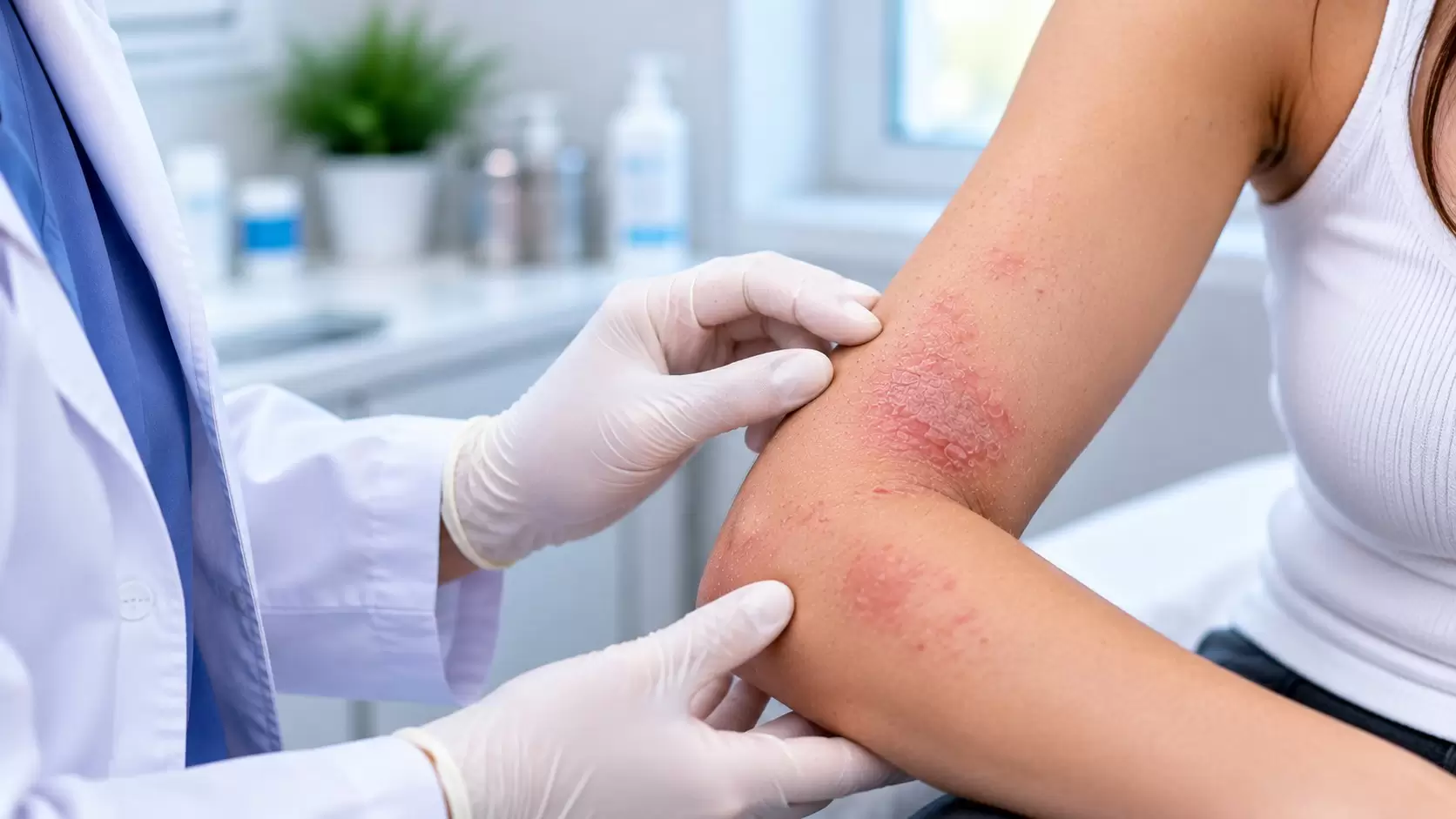
Eczema and psoriasis can look similar
Both conditions can produce dry, scaly and inflamed skin, and both can occur in children and adults. The American Academy of Dermatology notes that distinguishing them is not always straightforward, particularly in children, and overlap can occur.
A dermatologist uses the appearance of the lesions, degree of itch, distribution, age, history, nail findings and other clinical clues rather than relying on a single feature.
Eczema vs psoriasis at a glance
| Feature | Eczema / atopic dermatitis | Plaque psoriasis |
|---|---|---|
| Typical appearance | Dry, inflamed, scaly or rough skin; may ooze or crust during active flares | Often well-defined, thicker raised plaques with scale |
| Itching | Often intense and can disturb sleep | Can itch, but the degree varies |
| Common sites | Often flexures such as elbow and knee creases; distribution changes with age | Commonly elbows, knees and scalp; other sites can also be involved |
| Skin barrier | Dryness and impaired barrier function are prominent | Rapid skin-cell turnover and immune-mediated inflammation produce plaques |
| Nails | Can be affected indirectly by chronic dermatitis or scratching | Pitting, lifting and other characteristic nail changes may occur |
| Contagious? | No | No |
How the appearance can differ
Atopic dermatitis often produces very dry, itchy, inflamed skin. Scratching may lead to raw areas, oozing, crusting or thickened leathery skin over time. The colour of inflammation varies with skin tone and may appear red, pink, brown, purple, grey, lighter or darker than surrounding skin.
Chronic plaque psoriasis classically forms well-demarcated raised plaques with scale. Psoriasis can also look different across skin tones and has several subtypes, so not every case has the textbook appearance.
Where they commonly appear
Eczema
Atopic dermatitis often affects the creases of elbows and knees in older children, as well as the neck, wrists and ankles. Babies commonly develop eczema on the face and scalp. Adults can develop it on the hands, around the eyes and elsewhere.
Psoriasis
Plaque psoriasis commonly affects the elbows, knees and scalp, but it can involve many other sites. Inverse psoriasis affects skin folds, demonstrating why location alone cannot establish the diagnosis.
Which condition itches more?
Intense itch is a hallmark of atopic dermatitis and may begin before a visible rash. The AAD notes that children with eczema can have intense itching. Psoriasis can also itch—sometimes significantly—but thick, sharply defined plaques and typical distribution may point toward psoriasis in the appropriate clinical context.
If itching and dryness are new, see Early Signs of Eczema.
What causes eczema and psoriasis?
Both involve the immune system, but they are biologically distinct diseases. Atopic dermatitis involves immune dysregulation together with impaired skin-barrier function and genetic and environmental influences. Psoriasis is an immune-mediated disease in which skin cells are produced much faster than normal, leading to accumulation and visible plaques.
Neither condition is contagious. You cannot catch eczema or psoriasis through touching someone who has it.
Learn more in Eczema Causes, Symptoms & Types and Psoriasis Causes, Symptoms & Types.
Do they have the same triggers?
There can be overlap, but triggers are not identical. Eczema can be aggravated by soaps, detergents, fragrance, rough fabrics, heat, sweating, weather changes and stress. Psoriasis can flare with skin injury, infections, stress, certain medicines and other factors.
Trigger patterns vary substantially between individuals. See Eczema Triggers and Psoriasis Triggers & Flare-Ups.
Are treatments different?
Yes. Both conditions may use moisturisers and anti-inflammatory topical medicines, but treatment selection and long-term strategies differ. Atopic dermatitis management emphasises skin-barrier care and eczema-specific anti-inflammatory therapies. Psoriasis may be treated with psoriasis-specific topical medicines, phototherapy, systemic drugs or biologic therapies depending on severity.
Some medicines can be used in both conditions in selected circumstances, but that does not make the diseases interchangeable. Correct diagnosis is important before choosing treatment.
For local treatment information, see Eczema Treatment in Chennai and Psoriasis Treatment in Chennai.
How does a dermatologist tell the difference?
Diagnosis is usually clinical. The dermatologist examines the morphology and distribution of the rash, asks about itch and symptom history, and looks for supporting features such as nail psoriasis or an atopic history. DermNet notes that eczema diagnosis requires considering and excluding other conditions, including psoriasis, when the presentation is atypical or treatment response is poor.
Occasionally, additional testing or a skin biopsy may be considered when the diagnosis remains uncertain.
Frequently asked questions
Which is itchier, eczema or psoriasis?
Eczema often causes intense itching and itch is a hallmark of atopic dermatitis. Psoriasis can also itch, and individual symptom severity varies.
Can you have eczema and psoriasis at the same time?
Yes. Although they are distinct conditions, overlap can occur and some people can have features of both.
Are eczema and psoriasis contagious?
No. Neither atopic dermatitis nor psoriasis spreads from person to person through touch.
Does eczema usually affect skin folds?
Atopic dermatitis commonly affects elbow and knee creases in older children, but distribution varies with age. Psoriasis can also occur in folds, particularly inverse psoriasis.
Can a dermatologist diagnose eczema and psoriasis by looking at the skin?
Often yes. Diagnosis is usually clinical, based on appearance, distribution and history. Additional testing or biopsy may occasionally be needed when the diagnosis is uncertain.
Do eczema and psoriasis use the same treatment?
Some supportive and anti-inflammatory treatments overlap, but they are different diseases and their treatment strategies can differ substantially. An accurate diagnosis is important.
For authoritative information, see the American Academy of Dermatology and DermNet eczema diagnostic guidance.
Visit us in OMR
Not sure whether it is eczema or psoriasis?
Book a dermatologist consultation at Ram Skin Clinic in Thoraipakkam, Chennai.
#48, Second Floor, Flat E, Best Towers,Okkiampet, Thoraipakkam, OMR,
Chennai – 600097. Above Domino’s Pizza.