
Understanding Psoriasis
Psoriasis Causes, Symptoms & Types
Psoriasis is a chronic immune-mediated inflammatory condition that can affect the skin, scalp and nails and, in some people, is associated with psoriatic arthritis.
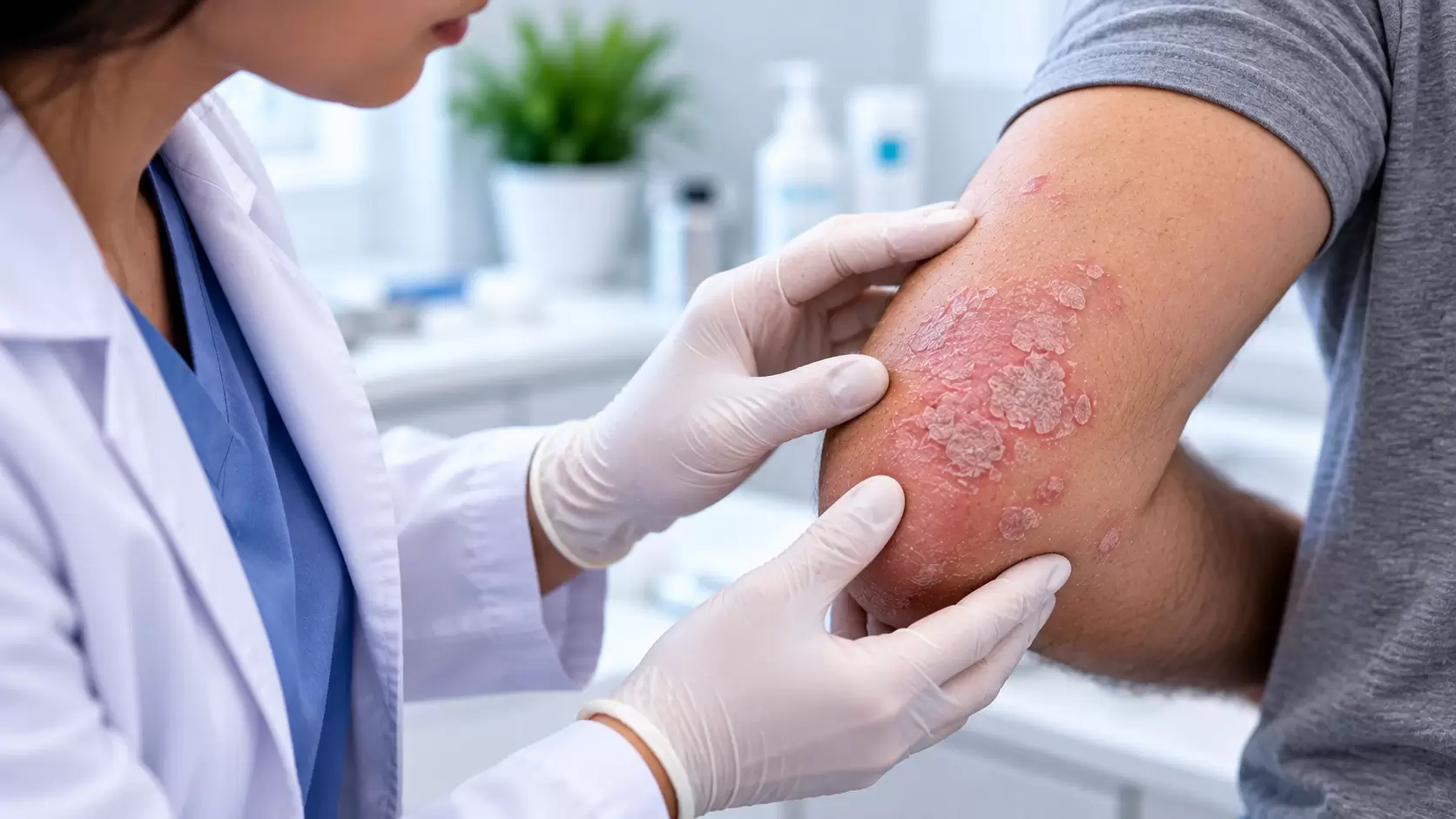
What exactly is psoriasis?
Psoriasis is a long-term inflammatory skin disease in which immune activity drives skin cells to build up more rapidly than usual. This can produce clearly defined, raised or thickened areas of skin with scale. The condition often follows a relapsing course: symptoms may flare for weeks or months and then become less noticeable for a period.
Psoriasis can begin at different ages and can affect people of any ethnicity. It is not an infection and cannot be caught from another person. If you already have a diagnosis and want to understand management options, see our Psoriasis Treatment in Chennai pillar page.
What causes psoriasis?
There is no single cause. Current evidence describes psoriasis as an immune-mediated disease involving genetic susceptibility and environmental influences. In susceptible people, immune signalling promotes inflammation and accelerated skin-cell production.
Immune system
Immune cells and inflammatory signalling pathways become overactive. This contributes to inflammation and the rapid turnover of skin cells that produces characteristic plaques and scale.
Genetics
Psoriasis can run in families, and several genes are associated with susceptibility. Having a genetic predisposition does not mean a person will necessarily develop psoriasis.
Triggers
Infections, stress, skin injury and certain medicines can trigger psoriasis or a flare in some people. Triggers vary considerably between individuals.
Lifestyle and health factors
Smoking and obesity are among factors associated with psoriasis risk or severity. Management therefore looks beyond the visible skin when clinically appropriate.
A future guide in this series will look specifically at psoriasis triggers and flare-ups, including how to identify patterns without assuming every flare has one obvious cause.
Common psoriasis symptoms
Symptoms differ by psoriasis type, body site and severity. Typical plaque psoriasis often produces well-demarcated patches with scale, commonly involving the scalp, elbows, knees or lower back, although any skin site may be affected.
- Raised, thick or clearly defined scaly patches or plaques.
- Silvery-white scale, although colour and appearance vary with skin tone.
- Itching, burning, tenderness or soreness.
- Dry or cracked skin that may sometimes bleed.
- Scalp scaling or plaques that may extend beyond the hairline.
- Nail pitting, discolouration, thickening, crumbling or separation of the nail from the nail bed.
Joint symptoms matter too. Persistent joint pain, swelling or stiffness, back or neck pain, or pain around tendon attachments can occur with psoriatic arthritis and deserve medical assessment. Untreated psoriatic arthritis can lead to irreversible joint damage.
Main types of psoriasis
Plaque psoriasis
The most common form. It causes persistent, well-defined raised plaques with scale, often on the scalp, elbows, knees, lower back or other areas.
Guttate psoriasis
Often presents as many small scaly spots over the trunk or limbs and is seen particularly in children and younger adults. It can follow an infection such as streptococcal throat infection.
Inverse or flexural psoriasis
Develops in skin folds such as the armpits, groin or other areas where skin touches skin. The surface tends to be smoother and may have less obvious scale because of moisture and friction.
Pustular psoriasis
Produces sterile pus-filled bumps with inflamed skin. Localised forms often affect the hands or feet, while generalised pustular psoriasis is uncommon and can be a medical emergency.
Erythrodermic psoriasis
A rare, severe form involving widespread inflamed, scaly skin. Because it can affect temperature regulation and fluid balance, urgent medical assessment is required.
Scalp and nail psoriasis
Psoriasis may be prominent on the scalp or nails. Nail changes can occur with skin psoriasis and can also be clinically important when assessing possible psoriatic arthritis.
Psoriasis can change over time
A person may have one psoriasis pattern for years and later develop another. Severity can also fluctuate. Skin injury can sometimes lead to new lesions at the injured site, a response known as the Koebner phenomenon.
Because several skin disorders can resemble psoriasis, diagnosis should not be based only on an online photograph. Eczema, fungal infection, seborrhoeic dermatitis and other inflammatory conditions can overlap in appearance. Our upcoming cluster also covers psoriasis vs eczema and the early signs of psoriasis.
How is psoriasis diagnosed?
A dermatologist usually assesses the appearance and distribution of the skin changes, scalp and nails together with your medical and family history. The effect on daily life and symptoms suggesting joint involvement are also relevant. In less typical cases, a skin biopsy may occasionally help support the diagnosis or exclude another condition.
Once psoriasis is identified, management depends on its type, body sites, extent, severity, previous treatment response and the person’s overall health. Read the clinic’s main guide to psoriasis treatment in Chennai for the next step.
Frequently asked questions
Is psoriasis contagious?
No. Psoriasis is an immune-mediated inflammatory disease and cannot be passed from person to person by touching, sharing a pool or normal close contact.
What is the most common type of psoriasis?
Plaque psoriasis is the most common form. It typically causes well-defined raised plaques with scale, often on the scalp, elbows, knees or lower back.
Can psoriasis affect the scalp and nails?
Yes. Scalp psoriasis may range from relatively thin scaling to thick plaques, and nail psoriasis can cause pitting, discolouration, thickening, crumbling or lifting of the nail.
Can stress cause psoriasis?
Stress can be a trigger or aggravating factor for some people, but psoriasis is not simply caused by stress. Genetics, immune activity and multiple environmental factors contribute.
Does everyone with psoriasis get arthritis?
No. Only some people with psoriasis develop psoriatic arthritis. Joint pain, swelling or stiffness should nevertheless be discussed with a doctor because early recognition is important.
Can psoriasis be cured permanently?
Psoriasis is generally considered a chronic condition. Treatments can reduce symptoms and control disease activity, but individual response and the duration of remission vary.
For authoritative patient information, see the National Institute of Arthritis and Musculoskeletal and Skin Diseases, the American Academy of Dermatology and DermNet.
Visit us in OMR
Concerned about psoriasis symptoms?
Book a dermatology consultation at Ram Skin Clinic in Thoraipakkam, Chennai.
#48, Second Floor, Flat E, Best Towers,Okkiampet, Thoraipakkam, OMR,
Chennai – 600097. Above Domino’s Pizza.