
Mole Assessment
Normal Mole vs Suspicious Mole
Most moles are harmless. The important question is whether a spot is new, changing, noticeably different from your other moles, or showing features that deserve a dermatologist’s assessment.
Understanding Moles
What Does a Normal Mole Usually Look Like?
A mole, medically called a melanocytic naevus or nevus, is a common skin growth made up of pigment-producing cells. According to the American Academy of Dermatology, a typical common mole is often one colour, round, flat or slightly raised, and generally unchanged from month to month.
Normal moles are not required to look identical. Even on the same person they can vary in colour, size and whether they are flat or raised. Some contain hair, and some may change gradually over many years. The useful comparison is therefore not simply with a photograph on the internet, but also with the pattern of moles on your own skin.
Features Often Seen in Common Moles
- Round or oval overall shape
- Relatively symmetrical appearance
- Smooth, reasonably even border
- One colour or a regular colour pattern
- Stable appearance over time
Features Worth Checking
- New or obvious change in an existing mole
- Asymmetry or irregular outline
- Multiple or unevenly distributed colours
- A spot unlike your other moles
- Bleeding, crusting, persistent itching or pain
ABCDE Rule
Signs of a Suspicious Mole
Dermatologists commonly use the ABCDE rule as a screening guide for pigmented lesions. It helps identify changes that should prompt professional assessment rather than serving as a diagnosis by itself.
A — Asymmetry
One half of the spot does not resemble the other half in shape, colour or structure.
B — Border
The edge may be irregular, scalloped, jagged or poorly defined instead of smooth and even.
C — Colour
There may be uneven colour or several shades within one lesion, rather than a consistent pattern.
D — Diameter
Melanomas are often larger than 6 mm when diagnosed, but they can also be smaller. Size alone should never be used to rule a lesion in or out.
E — Evolving
Change in size, shape, colour or overall appearance is especially important. A lesion that starts behaving differently deserves attention.
Different — The Ugly Duckling
A mole that looks distinctly unlike the rest of your moles can be important even if it does not neatly meet every ABCDE feature.
See the American Academy of Dermatology’s ABCDE guide and DermNet’s melanoma screening guide for additional clinical information.
Change Matters
Why Evolution Is So Important
A photograph captures only one moment. Dermatologists are also interested in what has happened to the lesion over time. A mole that was previously stable but begins growing, changing shape or developing new colours may warrant assessment.
Other reasons to arrange an examination include a spot that persistently itches, bleeds without an obvious injury, becomes crusted or painful, or repeatedly fails to heal. A new pigmented lesion in adult life can also deserve closer evaluation depending on the person’s age and clinical context.
If you are unsure whether a change is significant, our guide on when to get a mole checked explains the warning signs in more detail.
What Happens During a Dermatologist Assessment?
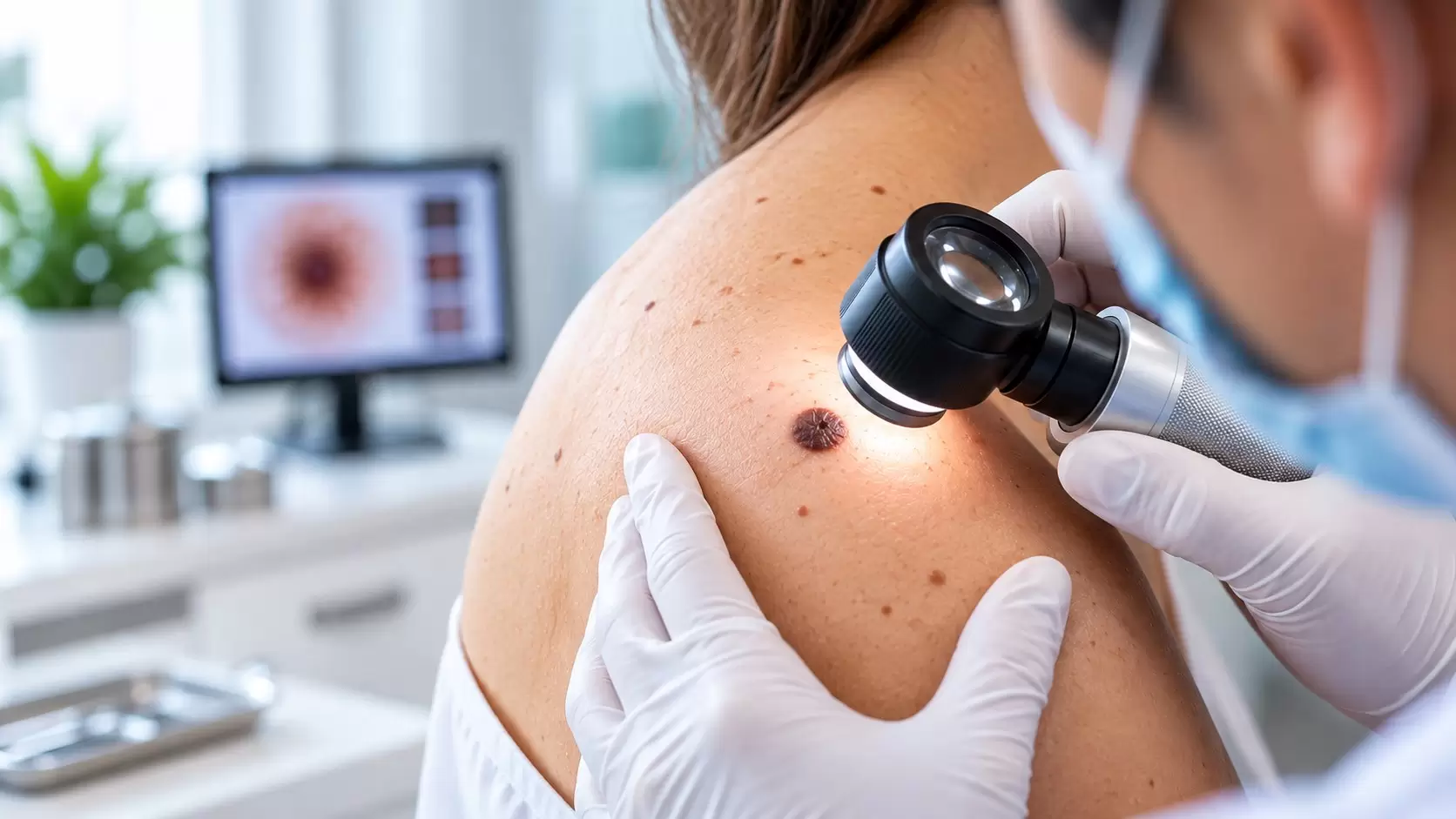
The dermatologist will usually ask when you first noticed the lesion and whether it has changed. The mole is examined clinically and may also be assessed with dermoscopy, which provides a magnified view of structures and pigment patterns that are not as easy to evaluate with the naked eye.
If the diagnosis remains uncertain or the lesion has suspicious features, tissue may need to be removed and examined under a microscope. Our skin biopsy in Chennai page explains why histopathology may be recommended for selected skin lesions.
If a mole is clinically benign but causes repeated irritation or is being considered for cosmetic removal, the options can be discussed after assessment. Visit our Mole Assessment & Removal in Chennai page for more information.
Frequently Asked Questions
Normal vs Suspicious Mole FAQs
Does an irregular mole always mean melanoma?
No. Benign moles and other non-cancerous skin lesions can have irregular features. A dermatologist evaluates the entire clinical picture and may use dermoscopy or biopsy when necessary.
Can a melanoma be smaller than 6 mm?
Yes. The 6 mm diameter in the ABCDE guide is a useful warning feature, not a minimum size. Melanomas can be smaller.
Is a raised mole suspicious?
Not necessarily. Many benign moles are raised. A new change, rapid growth, unusual appearance, bleeding or other concerning features matter more than elevation alone.
Should a mole that looks different from all my others be checked?
Yes. Dermatologists call this the ugly duckling concept. A lesion that stands out from your usual pattern of moles is worth professional assessment.
Can a dermatologist tell whether a mole is cancerous just by looking?
Clinical examination and dermoscopy can provide important information, but when a lesion remains suspicious, histopathological examination of tissue may be required for diagnosis.
Visit us in OMR
Concerned About a Mole?
Book a consultation at Ram Skin Clinic in Thoraipakkam, Chennai for dermatologist-led mole assessment.
#48, Second Floor, Flat E, Best Towers,Okkiampet, Thoraipakkam, OMR,
Chennai – 600097. Above Domino’s Pizza.