
Psoriasis Facts
Is Psoriasis Contagious?
No. Psoriasis is not contagious. You cannot catch it by touching someone, sharing everyday items, swimming together or being physically close to a person who has psoriasis.
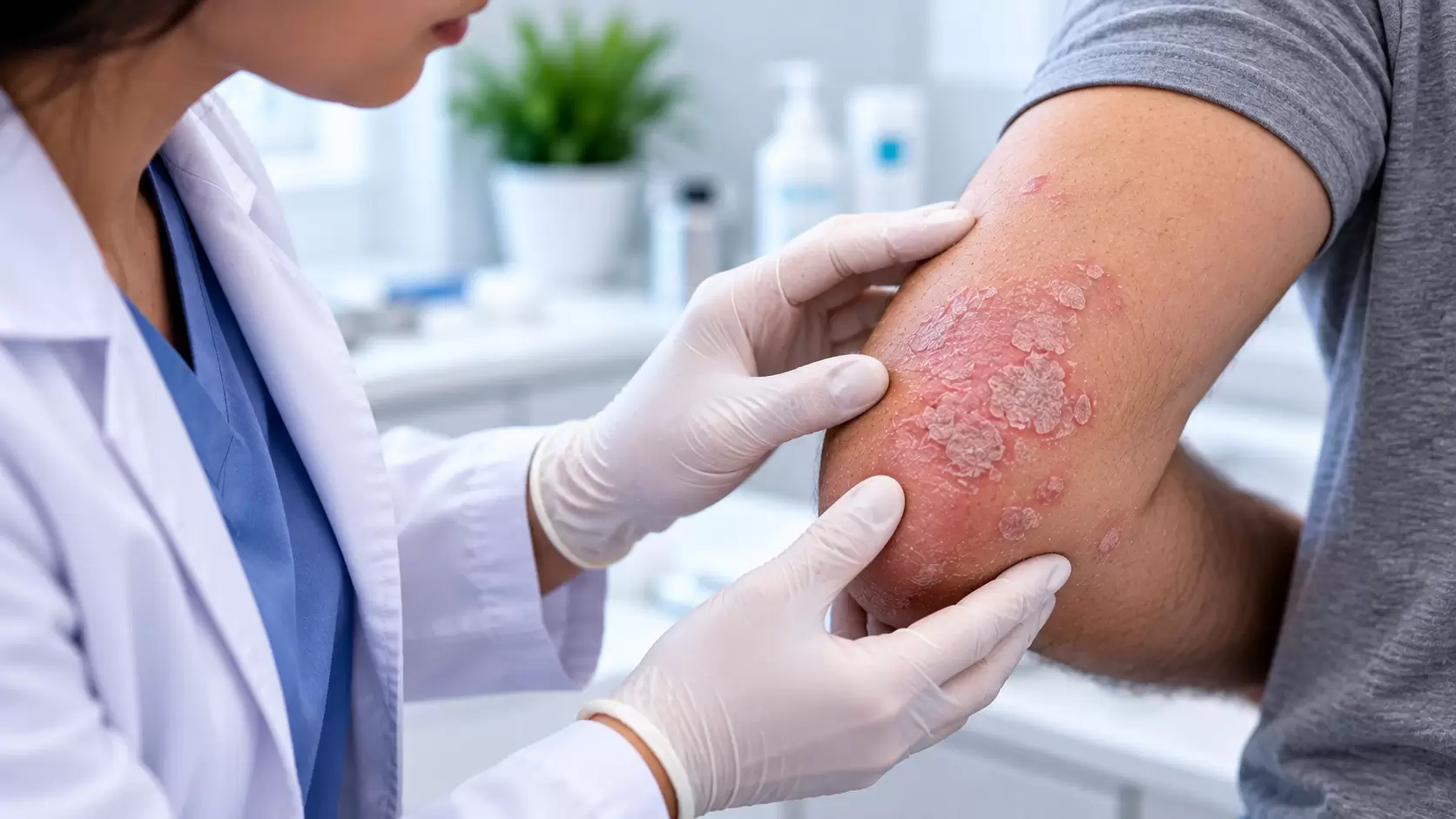
Can you catch psoriasis from another person?
No. Psoriasis does not spread through skin-to-skin contact and cannot be transmitted through coughing, sneezing, sexual contact, swimming pools or shared household items. Touching a psoriasis plaque will not give you psoriasis.
The condition develops because of interactions between the immune system, genetics and environmental factors. It is therefore fundamentally different from contagious skin diseases caused by fungi, bacteria, viruses or parasites.
If you are learning about the condition for the first time, start with our guide to Psoriasis Causes, Symptoms & Types.
Why can psoriasis look infectious?
Visible scaling
Psoriasis can produce thick scale and shedding skin. Although this can look concerning, the scale does not contain an infectious agent that spreads psoriasis to another person.
Inflamed skin
Plaques may look red, violet, brown, grey or darker than surrounding skin depending on skin tone. Inflammation is part of the disease process, not evidence that psoriasis is contagious.
Cracking or bleeding
Very dry or thick plaques can crack or bleed. This can look similar to some infected skin conditions, but cracking does not make psoriasis itself infectious.
Scalp flaking
Scalp psoriasis can cause conspicuous flaking and plaques. It cannot be spread by touching the scalp or through normal contact with someone who has the condition.
Learn more about scalp involvement in Scalp Psoriasis: Symptoms & Treatment.
If it is not contagious, what causes psoriasis?
Psoriasis is an immune-mediated disease. Immune activity drives skin cells to turn over much faster than normal, contributing to the characteristic plaques and scale. Genetics also matter: psoriasis can run in families, although having a family member with psoriasis does not mean you will definitely develop it.
Environmental and health-related factors can trigger the onset or worsening of psoriasis in susceptible people. These can include stress, skin injury, certain infections, weather and some medicines.
For more detail, see Psoriasis Triggers & Flare-Ups.
Can psoriasis spread on your own body?
Psoriasis can become more extensive over time or appear in new locations, but this is not contagious spread. New plaques may develop because the inflammatory disease is more active.
Skin injury can also provoke a new psoriasis lesion at the injured site in susceptible people—a response known as the Koebner phenomenon. Scratching, cuts, burns and sunburn are examples of skin trauma that may contribute.
If new areas are appearing quickly or your usual treatment is no longer controlling the disease, a dermatologist can reassess severity and treatment.
Psoriasis vs contagious skin conditions
Several infections can cause itchy, scaly or inflamed skin and may sometimes resemble psoriasis. Fungal infections, for example, can produce scaly plaques and are contagious in some circumstances. Scabies and certain bacterial or viral skin diseases are also transmissible.
This is one reason self-diagnosis based only on photographs can be unreliable. If the rash is new, changing, spreading rapidly or the diagnosis is uncertain, a dermatologist can distinguish psoriasis from eczema, fungal infection and other causes.
Our comparison of Psoriasis vs Eczema explains another common source of confusion. You can also read about skin infections and when medical assessment is useful.
Can you safely touch someone with psoriasis?
Yes. Normal physical contact with someone who has psoriasis does not transmit the disease. There is no medical reason to avoid shaking hands, hugging, sharing a home or otherwise interacting normally because of psoriasis.
Visible psoriasis can nevertheless carry social stigma. Understanding that it is not contagious is important because avoiding physical contact can unnecessarily affect a person’s confidence, relationships and quality of life.
When should psoriasis be checked?
Arrange a dermatologist assessment if you have persistent or recurring scaly plaques, scalp symptoms, nail changes or a rash that has not been clearly diagnosed. Also mention recurring joint pain, stiffness or swelling because psoriasis can be associated with psoriatic arthritis.
If you have already been diagnosed, review is appropriate when the condition is becoming more extensive, frequent flares are occurring, symptoms are interfering with daily life or your current treatment is no longer effective.
For diagnosis and treatment information, visit Psoriasis Treatment in Chennai.
Frequently asked questions
Can psoriasis spread by touching?
No. Psoriasis is not contagious and cannot be transmitted by touching psoriasis plaques or normal skin contact.
Can psoriasis spread through towels or clothes?
No. Psoriasis itself cannot be caught through shared towels, clothing, bedding or household items.
Can you get psoriasis from swimming with someone who has it?
No. Psoriasis is not an infection and cannot be transmitted through a swimming pool or by swimming with someone who has psoriasis.
Is scalp psoriasis contagious?
No. Scalp psoriasis is not contagious. Its flakes and plaques do not spread psoriasis to another person.
If psoriasis runs in families, is it contagious?
No. Genetic susceptibility and contagious transmission are completely different. Psoriasis can run in families because genes influence risk, not because relatives pass the condition to one another through contact.
Can an infection cause psoriasis?
Some infections can trigger psoriasis in susceptible people. A classic example is guttate psoriasis after streptococcal throat infection. This is a trigger of the immune-mediated disease, not person-to-person transmission of psoriasis.
For authoritative patient information, see the American Academy of Dermatology, DermNet and NHS.
Visit us in OMR
Have a persistent scaly rash?
Book a dermatologist consultation at Ram Skin Clinic in Thoraipakkam, Chennai.
#48, Second Floor, Flat E, Best Towers,Okkiampet, Thoraipakkam, OMR,
Chennai – 600097. Above Domino’s Pizza.