
Microneedling RF Results
MNRF Treatment Results: Sessions, Timeline and What to Expect
MNRF results develop gradually because the treatment is designed to trigger tissue repair and collagen remodelling. The final effect cannot be judged from the redness, swelling or temporary plumping seen immediately after a session.
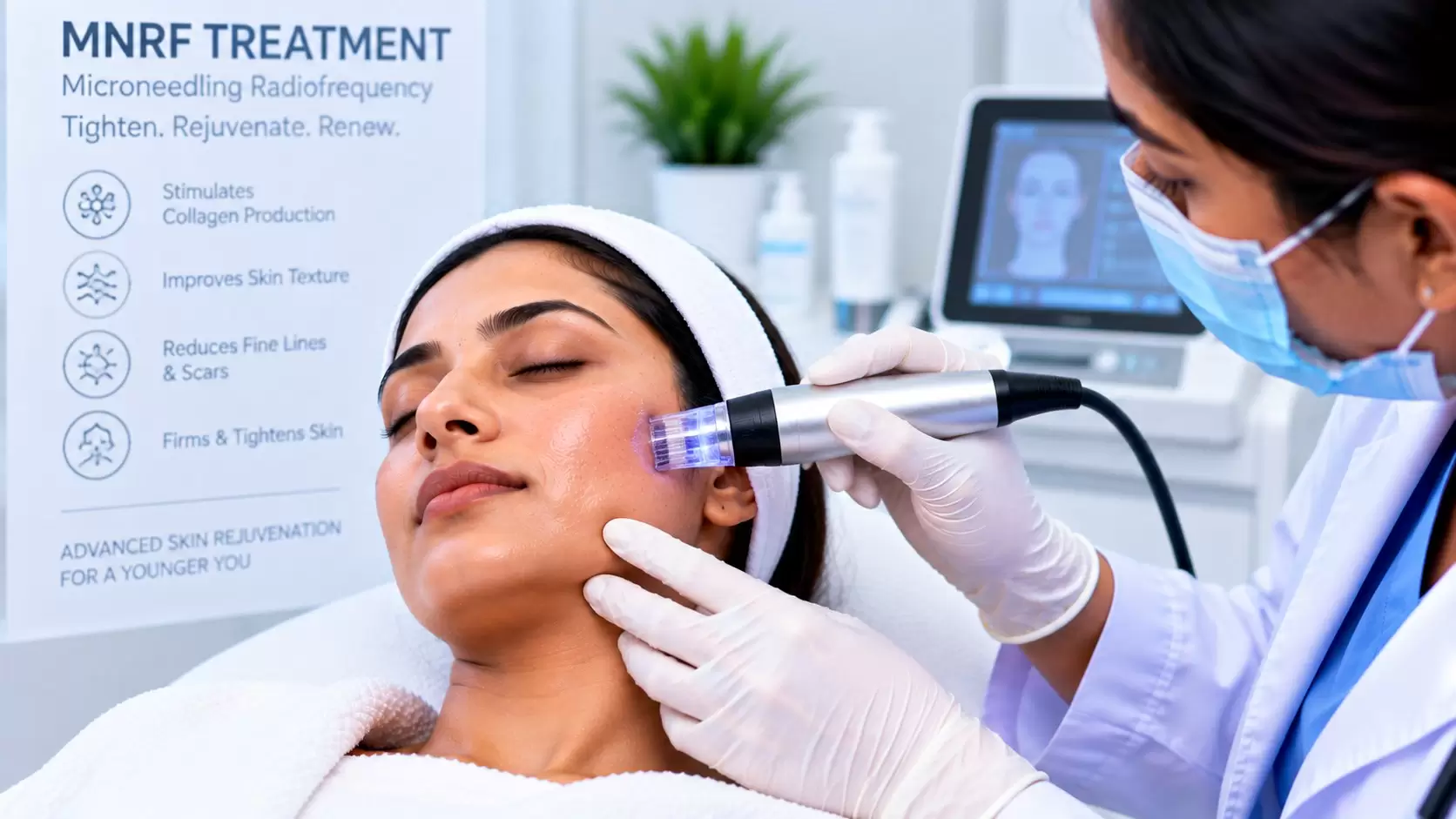
Why MNRF results take time
MNRF creates controlled microscopic injury and delivers radiofrequency energy within targeted skin tissue. This initiates a healing response rather than producing an instant structural replacement of scar tissue.
Collagen remodelling is a biological process that develops progressively. For this reason, the appearance of the skin immediately after treatment is not a reliable measure of the eventual result.
For the mechanism, read What Is MNRF Treatment?.
A practical MNRF timeline
First 24–72 hours
Redness, warmth, swelling and tenderness can occur. These are treatment reactions rather than the final cosmetic result.
First week
Surface recovery continues. Dryness, mild roughness, tiny crusts or grid-like marks may be visible depending on the treatment intensity.
Following weeks
As inflammation settles, gradual changes in texture may begin to become easier to assess.
Following months
Collagen remodelling continues, making later follow-up more meaningful for evaluating scar and texture improvement.
How many MNRF sessions are needed?
There is no single session count appropriate for every patient. A series of treatments is commonly used because each session creates a controlled remodelling stimulus and the skin needs time to heal between procedures.
The treatment course depends on the indication, severity, scar type, device, settings, previous procedures and response.
What improvement can you realistically expect?
For acne scars, the goal is usually to soften scar depth, edges and overall texture—not to create completely scar-free skin. For broader texture concerns, the goal may be a smoother and more even surface.
The degree of change varies substantially. Some scars may respond more noticeably than others on the same face because their depth and structure differ.
Which acne scars may show better results?
Selected rolling and boxcar scars can respond to dermal remodelling. Deep ice-pick scars or scars tethered by fibrous bands may require targeted procedures in addition to MNRF.
This is why scar mapping is important before treatment. Read MNRF for Acne Scars for a scar-type breakdown.
What affects MNRF results?
Scar architecture
Rolling, boxcar, ice-pick and tethered scars do not respond identically to one procedure.
Treatment parameters
Needle depth, RF energy, passes and device characteristics influence the treatment delivered.
Skin response
Healing, inflammation and tendency to post-inflammatory pigmentation vary between individuals.
Combination treatment
Subcision or other scar-directed procedures may improve the plan when MNRF alone cannot address every scar component.
Does a stronger MNRF session give better results?
Not necessarily. Increasing depth or energy also increases tissue injury and can increase downtime and complication risk. The objective is controlled treatment at an appropriate level—not maximum intensity.
This is particularly relevant in darker, pigment-prone skin, where excessive inflammation may increase the chance of post-inflammatory hyperpigmentation.
How long should you wait between sessions?
Treatment intervals should allow the skin to recover and the biological remodelling process to progress. Protocols vary according to device, intensity, indication and individual healing.
Your dermatologist should determine the interval rather than repeating treatment simply because visible redness has disappeared.
How should MNRF results be measured?
Standardised photographs are valuable because lighting and camera angle can dramatically change how acne scars appear. Images should ideally be taken with similar lighting, distance, angle and facial position.
Clinical assessment can also consider scar depth, edges, texture and patient-reported satisfaction rather than relying on one close-up photograph.
Why before-and-after photos can be misleading
Harsh side lighting exaggerates depressed scars, while frontal soft lighting can make the same scars appear much shallower. Makeup, skin hydration, image processing and temporary swelling can also change appearance.
Before-and-after photographs are most useful when conditions are standardised and enough time has passed for post-treatment inflammation to settle.
MNRF vs microneedling results
Both procedures can stimulate remodelling through controlled needle injury. MNRF adds radiofrequency energy within the skin, creating an additional thermal component.
Neither is automatically superior for every patient. Scar morphology, skin type and treatment goals should determine the approach. See MNRF vs Microneedling for Acne Scars.
Can MNRF results be permanent?
Remodelling of an existing scar can be long-lasting, but skin continues to age and new acne can produce new scars. MNRF also cannot guarantee that treated scars disappear completely.
Controlling active acne is therefore an important part of protecting the improvement achieved from scar procedures.
When should the treatment plan be reassessed?
If improvement is limited after an appropriate course and follow-up period, repeating the same procedure indefinitely may not be useful. The dermatologist can reassess scar architecture and consider whether another technique should be added or substituted.
For treatment-specific information, visit MNRF Treatment in Chennai.
Frequently asked questions
How long does MNRF take to show results?
Early healing occurs over days, but collagen remodelling and meaningful texture or scar changes are generally assessed over weeks to months.
How many MNRF sessions do I need?
There is no universal number. The course depends on the indication, severity, scar type, device settings and individual response.
Will one MNRF session remove acne scars?
No. Established acne scars usually require a treatment plan rather than expecting complete removal from one session.
Do MNRF results continue after the session?
Yes. The intended remodelling response develops after treatment, so improvement can continue as the skin heals and collagen reorganises.
Can acne scars return after MNRF?
Remodelled scars do not simply “grow back,” but new active acne can create new scars and existing scars may remain partially visible.
MNRF treatment in OMR, Chennai
Want realistic MNRF results? Start with the right treatment plan.
Book a dermatologist consultation at Ram Skin Clinic in Thoraipakkam, Chennai.
#48, Second Floor, Flat E, Best Towers,Okkiampet, Thoraipakkam, OMR,
Chennai – 600097. Above Domino’s Pizza.