
Understanding Pigmented Skin Marks
Birthmark vs Mole: What’s the Difference?
The terms overlap more than many people realise. A birthmark is a broad description for a skin mark present at birth or shortly afterwards. A mole is a specific type of melanocytic skin lesion—and when a baby is born with one, that mole is also a birthmark.
What is a birthmark?
A birthmark is a coloured or structurally different area of skin that develops before birth or shortly afterwards. The term includes several biologically different conditions rather than one specific lesion.
Birthmarks may arise from blood vessels, melanocytes or other skin structures. They can be flat or raised and may be red, pink, blue-grey, tan, brown or another colour.
What is a mole?
A mole, medically called a melanocytic naevus, is a benign proliferation of melanocytes. Moles may be flat or raised and range from skin-coloured or pink to brown, blue or black.
Most ordinary moles are acquired and appear during childhood and adolescence. A mole present at birth or developing shortly afterwards is called a congenital melanocytic naevus.
Birthmark vs mole: the key differences
Birthmark
A broad category defined mainly by when the mark develops. It can be vascular, melanocytic or arise from other skin tissues.
Mole
A specific melanocytic lesion. It may be congenital or acquired depending on when it appears.
Colour
Birthmarks can be red, pink, purple, blue-grey, tan or brown. Moles are often tan or brown but can have other colours.
Natural history
Some birthmarks fade, while others persist. Most moles persist, although individual moles can lighten or occasionally disappear.
When a mole is also a birthmark
A congenital melanocytic naevus is both a mole and a birthmark. It is present at birth or develops shortly afterwards and can range from a small pigmented spot to a very large lesion.
Congenital naevi usually enlarge as a child grows and may become darker, more raised, bumpier or hairier, particularly around puberty.
Examples of birthmarks that are not moles
Many familiar birthmarks have nothing to do with melanocytic moles. Infantile haemangiomas and port-wine stains are vascular lesions, while café-au-lait macules and dermal melanocytosis are pigmented birthmarks with different biology from a melanocytic naevus.
See Common Types of Birthmarks for a broader overview.
Congenital moles vs acquired moles
Congenital melanocytic naevi are present at birth or shortly afterwards. Acquired melanocytic naevi develop later, with many appearing during childhood and adolescence.
Under the microscope, congenital naevi can also extend deeper into the skin and around skin structures more than typical acquired naevi. Clinically, however, the timing and history are often the first clues.
Do birthmarks and moles change with age?
Yes. The expected change depends on the lesion. Some vascular birthmarks fade, port-wine stains generally persist and can thicken, and congenital moles usually enlarge proportionally as a child grows.
Acquired moles can also grow with a child and may naturally lighten or darken. A change is more concerning when it is rapid, unusual or makes one lesion look distinctly different from the others.
Read Birthmarks and Age.
Does a congenital mole carry a melanoma risk?
Congenital melanocytic naevi have a melanoma risk that depends strongly on size and other features. DermNet notes that small and medium congenital naevi have a very low risk, while large or giant congenital naevi carry a higher risk and need individualised follow-up.
This is why the size, location and overall pattern matter more than simply saying that a mole was present at birth.
What changes in a mole should be checked?
Most childhood moles are harmless, and growing proportionally with the child is expected. The AAD recommends assessment when a mole changes quickly, looks different from the child’s other moles, develops several colours or a jagged border, bleeds without clear injury or becomes an open sore.
In adults, a new or changing mole also deserves assessment because change can be an early sign of melanoma.
Can you tell a birthmark from a mole just by looking?
Sometimes, but not always. A classic vascular birthmark may be visually distinct from a brown mole, while different pigmented lesions can look similar.
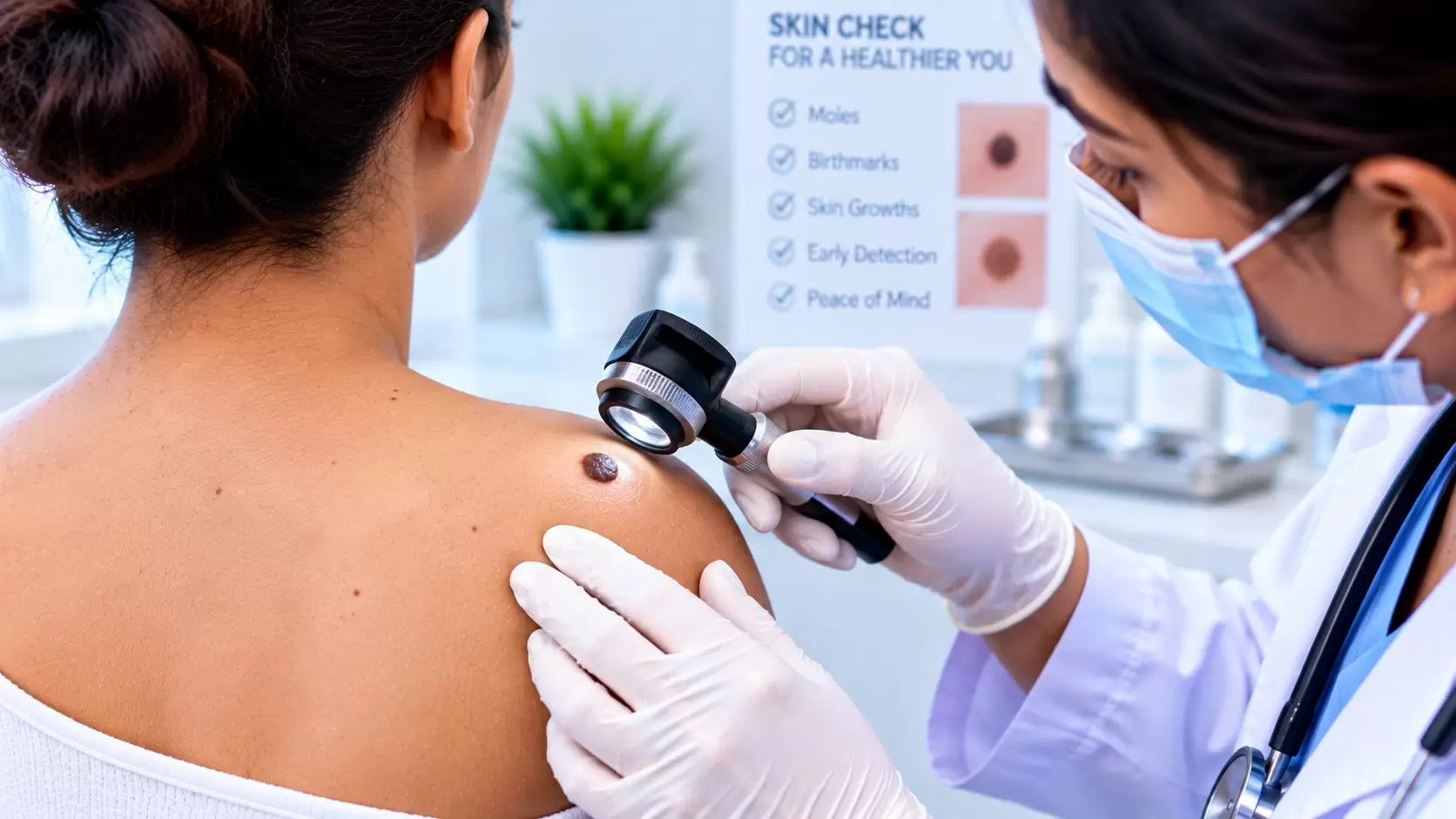
The dermatologist considers when the mark appeared, how it has changed, its colour, surface and borders, and whether there are other similar lesions. Dermoscopy can provide a magnified view of pigment structures when needed.
What about café-au-lait spots?
A café-au-lait macule is a pigmented birthmark but not a melanocytic mole. It is typically a flat, uniformly coloured tan-to-brown patch with a clear border.
A single café-au-lait spot is common. Multiple spots can be clinically important; dermatology assessment is recommended when a child has six or more or develops associated freckle-like spots.
What about a blue-grey birthmark?
Dermal melanocytosis can look blue-grey and may resemble a bruise. It is a birthmark caused by melanocytes located deeper in the skin, but it is not an ordinary mole.
These marks are common in Asian and other darker skin tones and often fade during early childhood.
How does a dermatologist assess a mole or birthmark?
Many lesions can be identified from the history and clinical appearance. Dermoscopy may be used for melanocytic lesions, while a Wood’s lamp can help with selected pigmentary birthmarks.
A biopsy is not routinely required for every birthmark or mole. It is considered when the diagnosis is uncertain or a suspicious change needs microscopic evaluation.
When should you arrange an assessment?
Rapid change
A mole or birthmark that changes much faster than expected should be examined.
Several colours or irregular border
New asymmetry, colour variation or an irregular outline warrants review.
Bleeding or ulceration
Repeated bleeding without clear trauma, pain or an open sore should not be ignored.
Large congenital mole
Large or giant congenital melanocytic naevi need dermatologist-led monitoring because their risk profile differs from small lesions.
For evaluation, visit Birthmark Assessment in Chennai.
Frequently asked questions
Is a mole a birthmark?
A mole is considered a birthmark when it is present at birth or appears shortly afterwards. This is called a congenital melanocytic naevus. Moles that develop later are usually acquired melanocytic naevi.
What is the main difference between a birthmark and a mole?
Birthmark is a broad term for skin markings present at birth or shortly afterwards and includes vascular and pigmented lesions. A mole is specifically a melanocytic naevus formed by a proliferation of melanocytes.
Can a birthmark look like a mole?
Yes. A congenital melanocytic naevus is both a mole and a type of pigmented birthmark.
Can new moles appear after birth?
Yes. Most ordinary acquired moles develop during childhood and adolescence rather than being present at birth.
When should a mole or birthmark be checked?
Assessment is recommended for rapid or unusual change, multiple colours, an irregular border, pain, itching, spontaneous bleeding, ulceration or a lesion that looks distinctly different from other moles.
Visit us in OMR
Not sure whether a mark is a birthmark or mole? Get it identified accurately.
Book a dermatologist consultation at Ram Skin Clinic in Thoraipakkam, Chennai.
#48, Second Floor, Flat E, Best Towers,Okkiampet, Thoraipakkam, OMR,
Chennai – 600097. Above Domino’s Pizza.