
Birthmark Warning Signs & Monitoring
When to Get a Birthmark Checked by a Dermatologist
Most birthmarks are harmless, but knowing the exact type matters because some fade naturally, some persist and a smaller group need monitoring or early treatment because of their size, location or behaviour.
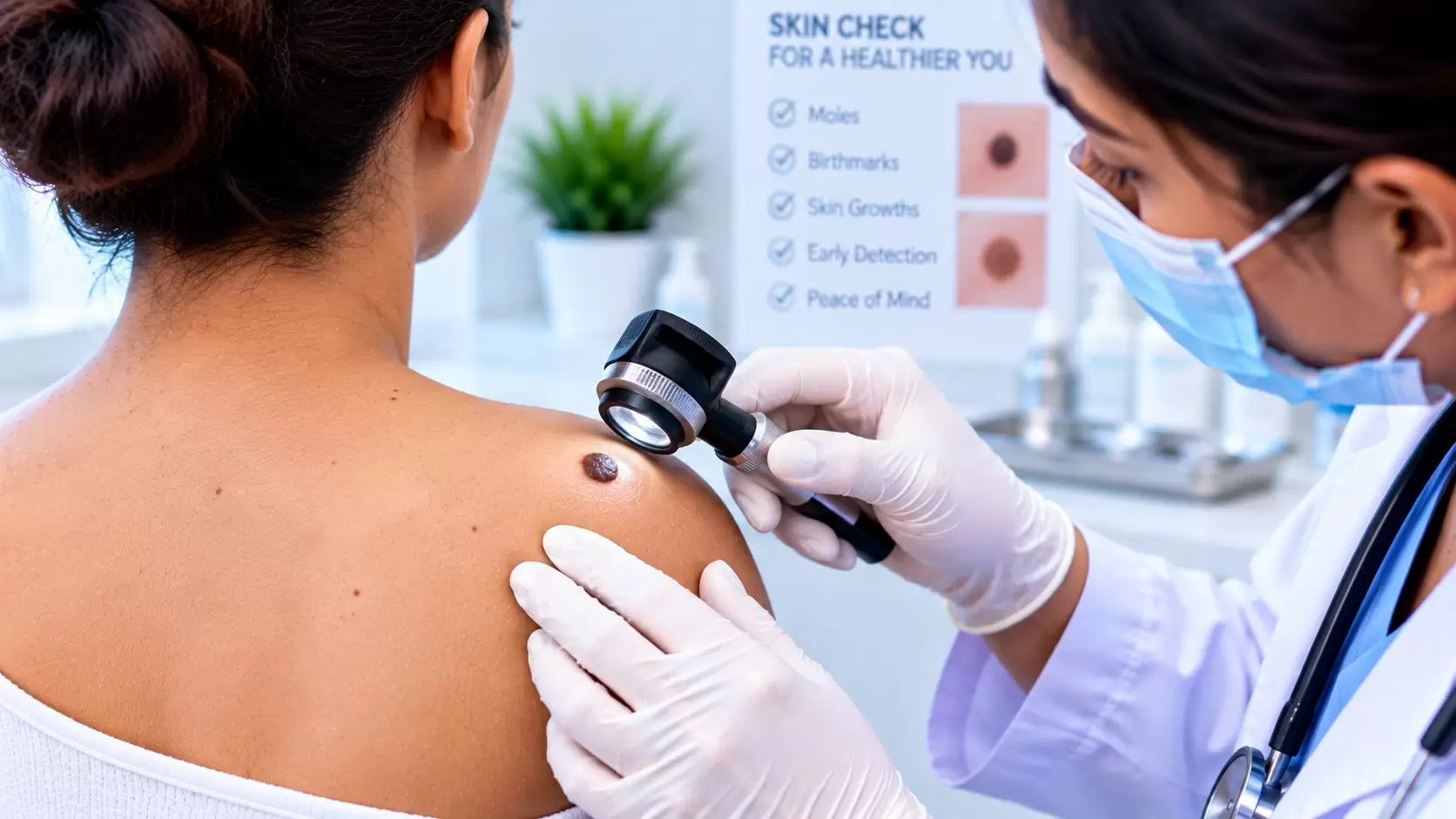
Should every birthmark be checked?
The American Academy of Dermatology advises having a dermatologist examine a birthmark when it is first noticed. Most are harmless, but identifying the type helps parents understand whether it is likely to fade, persist, grow temporarily or require treatment.
An initial assessment also creates a useful baseline for birthmarks that should be monitored over time.
Birthmark changes that deserve attention
Rapid or unexpected growth
Some birthmarks have predictable growth phases, but unexpectedly fast enlargement or a new change should be reviewed.
Pain or ulceration
A birthmark that becomes painful or breaks open may need wound care and treatment.
Bleeding without clear trauma
Spontaneous or repeated bleeding warrants assessment, particularly in a mole or changing growth.
Colour, border or texture changes
Rapid change, multiple colours, an irregular border or a lesion becoming very different from other moles should be examined.
Rapid growth does not always mean something dangerous
Some infantile haemangiomas naturally grow quickly during early infancy before eventually shrinking. That growth pattern can be normal for this type of vascular birthmark.
However, rapid growth can still create complications depending on the lesion’s size and location. Early assessment helps distinguish expected haemangioma growth from a birthmark that needs intervention.
Birthmarks near the eye, nose or mouth
Location can be as important as size. A haemangioma growing near the eye may interfere with vision, while lesions around the nose or mouth can potentially affect function depending on their extent.
These birthmarks should be assessed early rather than waiting to see how large they become, because some treatments work best during the growth phase.
When a birthmark becomes painful or breaks open
Ulceration can occur in some haemangiomas and may cause pain, bleeding and a risk of secondary infection. Appropriate wound care can improve comfort and healing.
If a birthmark develops an open area, crusting, persistent bleeding or obvious pain, arrange medical review rather than repeatedly applying home remedies.
When a congenital mole should be reassessed
A congenital melanocytic naevus can grow as a child grows, and some changes in colour or surface can occur over time. What matters is whether the change is expected or unusual.
The AAD advises dermatology review when a child’s mole grows or changes quickly, looks different from the child’s other moles, develops multiple colours or a jagged border, bleeds without an obvious reason or becomes an open sore.
See Common Types of Birthmarks for an overview of congenital moles and other birthmarks.
Why larger congenital moles need individual follow-up
Congenital melanocytic naevi vary greatly in size. Most small lesions are benign, but larger lesions have different monitoring considerations and a higher melanoma risk than small congenital naevi.
The dermatologist can document the size and features, explain what changes to watch for and decide whether observation, photography or another management approach is appropriate.
When café-au-lait spots should be checked
A single café-au-lait spot is common and usually harmless. The number and associated skin findings become more important when several are present.
The AAD recommends assessment when a child has six or more café-au-lait spots or when freckle-like spots develop around them, because this pattern can sometimes be associated with an underlying condition such as neurofibromatosis.
Port-wine stains and the value of early assessment
Port-wine stains are capillary malformations that generally do not disappear spontaneously. They can become darker and thicker with age.
Early dermatology assessment confirms the diagnosis and helps determine whether laser treatment is appropriate. Certain facial distributions can also be associated with other abnormalities and may need additional evaluation.
What changes are normal as a child grows?
A birthmark may enlarge proportionally as the child’s body grows. Congenital moles can become larger with growth, and some can become lighter or darker.
Infantile haemangiomas have a distinct early growth phase followed by gradual involution. Knowing the expected natural history of the specific birthmark helps avoid unnecessary alarm while still recognising abnormal change.
How to monitor a birthmark at home
Take clear photographs
Photographs in similar lighting and from a similar distance can make gradual changes easier to recognise.
Note symptoms
Record new pain, itching, bleeding, crusting or ulceration rather than monitoring appearance alone.
Watch the growth pattern
Notice whether the mark is simply growing with the child or changing much faster than expected.
Keep follow-up appointments
For birthmarks requiring monitoring, periodic review provides a more reliable comparison than memory alone.
What happens during a birthmark assessment?
The dermatologist examines the colour, surface, borders, size, location and distribution of the birthmark and asks when it first appeared and how it has changed.
Many birthmarks can be diagnosed clinically. A Wood’s lamp, dermoscopy, imaging or other investigations may be used in selected cases depending on the suspected type and whether deeper structures or an associated condition need evaluation.
Does every birthmark need treatment?
No. Observation is appropriate for many harmless birthmarks. Treatment is considered when the lesion creates a medical or functional problem, develops complications, carries a specific risk, or causes significant cosmetic or psychosocial concern.
Timing also matters. Some infantile haemangiomas benefit from early medical treatment, and port-wine stains may respond better when laser treatment is started earlier.
When to arrange a prompt review
Arrange dermatology review promptly if a birthmark or congenital mole is rapidly changing, repeatedly bleeding, painful, ulcerated or developing an open sore, or if it has a new irregular border or several colours.
Early review is also appropriate when a growing vascular birthmark is close to the eye, mouth, nose or another functionally important area.
Frequently asked questions
Should every birthmark be checked by a dermatologist?
Most birthmarks are harmless, but an initial dermatology assessment can identify the type, expected course and whether monitoring or treatment is needed.
What changes in a birthmark need assessment?
Rapid or unexpected growth, multiple colours, an irregular border, pain, spontaneous bleeding, ulceration or a birthmark that looks different from other marks should be assessed.
When does a haemangioma need early review?
Early review is particularly important for rapidly growing haemangiomas and those near the eye, nose, mouth or other areas where growth could affect function, as well as lesions that ulcerate or become painful.
Do multiple café-au-lait spots need assessment?
Yes. While a single café-au-lait spot is common, six or more spots or freckle-like spots around them should be assessed because this pattern can be associated with an underlying condition.
Should a congenital mole be monitored?
Yes. Congenital melanocytic naevi should be assessed so their size and features are documented. Rapid or unusual changes, bleeding, pain or a lesion that becomes very different from other moles warrants reassessment.
Visit us in OMR
Concerned about a birthmark or a recent change? Get it assessed accurately.
Book a dermatologist consultation at Ram Skin Clinic in Thoraipakkam, Chennai.
#48, Second Floor, Flat E, Best Towers,Okkiampet, Thoraipakkam, OMR,
Chennai – 600097. Above Domino’s Pizza.