
Laser Hair Reduction & Skin Tone
Laser Hair Removal for Indian Skin: Safety, Skin Tone and Pigmentation Risk
Laser hair reduction can be performed on Indian skin, but darker epidermal pigmentation changes how treatment should be planned. Wavelength, energy, pulse duration, cooling, tanning and hair characteristics all matter.
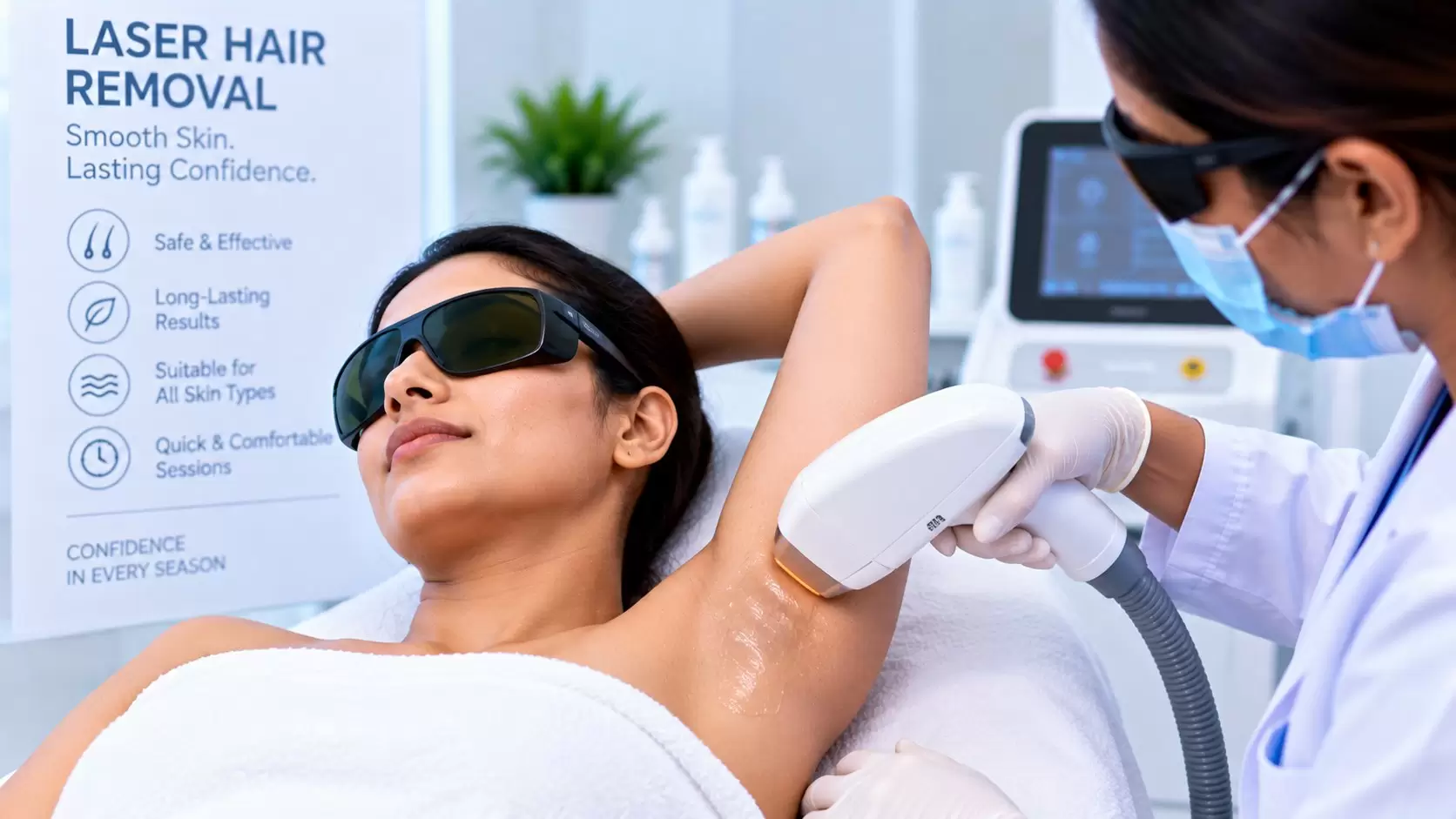
Why skin tone matters in laser hair removal
Hair-removal lasers work by directing light toward melanin in the hair. Melanin, however, is also present in the epidermis. In darker skin, there is more competing pigment in the surrounding skin that can absorb laser energy.
The treatment therefore needs to create useful heating around the hair follicle while limiting excessive epidermal heating. This balance is central to safe treatment of Indian skin.
For the underlying mechanism, read How Does Laser Hair Removal Work?.
Indian skin is not one skin tone
Indian patients have a broad range of skin tones, from relatively light to deeply pigmented. Two people of the same ethnicity can therefore require different laser parameters.
Baseline skin colour
The amount of epidermal melanin influences how much laser energy the surrounding skin may absorb.
Recent tanning
A tan temporarily increases epidermal pigment and can change the safety margin for treatment.
Hair thickness
Coarse dark hair generally provides a stronger target than very fine hair.
Treatment area
Hair characteristics and skin sensitivity vary between the face, underarms, legs and other areas.
What is selective photothermolysis?
The principle behind laser hair reduction is selective photothermolysis. A wavelength is chosen so that target pigment absorbs light, which is converted to heat. Pulse duration and energy are then controlled to produce useful thermal injury in the hair-bearing structure while limiting damage to surrounding tissue.
This selectivity is not absolute. That is why skin colour, hair colour and treatment parameters all need to be considered together.
Which laser is used for darker skin?
Different hair-removal systems use different wavelengths and pulse characteristics. Longer wavelengths such as 1064-nm Nd:YAG are commonly used for darker skin because epidermal melanin absorbs relatively less of this wavelength than shorter-wavelength systems.
Other technologies may also be used in appropriately selected patients. Device name alone does not determine safety; fluence, pulse duration, spot size, cooling, skin tone and operator technique are also important.
Why cooling is important
Cooling can protect the epidermis and improve comfort while energy is delivered to the hair target. Depending on the system, cooling may be built into the handpiece or delivered using another method.
Cooling is part of the overall safety strategy; it does not make inappropriate settings safe.
Can laser cause dark pigmentation?
Yes. Post-inflammatory hyperpigmentation can occur after excessive or even expected inflammation, particularly in skin that tends to darken after acne, burns or procedures.
Risk may be influenced by skin tone, recent sun exposure, treatment intensity, irritation after treatment and individual pigment response.
Can laser make the skin lighter?
Unwanted hypopigmentation—areas becoming lighter than surrounding skin—is a possible complication of excessive thermal injury. It is different from the temporary visual brightening that can occur when coarse dark hair is reduced.
Any persistent light or dark pigment change after laser treatment should be reviewed clinically.
What increases the risk of a laser burn?
Recent tanning
More epidermal pigment can absorb more energy and narrow the treatment safety margin.
Inappropriate parameters
Energy and pulse settings that do not account for skin type can cause excessive heating.
Overlapping treatment
Excessive pulse overlap or repeated treatment of the same area can increase thermal exposure.
Insufficient cooling
Cooling strategy is one factor used to protect the skin during treatment.
Why tanning matters before treatment
A recently tanned area contains increased epidermal melanin. Because the laser cannot distinguish “wanted” melanin in the hair from all pigment in the skin, tanning can increase competing absorption.
Tell the clinic about recent sun exposure, tanning or a change in skin colour. A session may need to be adjusted or postponed depending on the circumstances.
Is a patch test useful?
A test spot may be used in selected situations to observe how the skin responds to proposed parameters before treating a larger area. Whether it is needed depends on the device, skin type, treatment area, history and clinic protocol.
A patch test does not guarantee that a later full treatment cannot cause a reaction, but it can provide additional information when parameters are being selected.
What should normal skin look like after laser?
Mild temporary redness and swelling around individual follicles can occur after effective treatment. The skin may also feel warm or sensitive for a short period.
Severe persistent pain, blistering, extensive crusting or progressive skin discolouration is not something to ignore and should be reported to the treating clinic.
Does darker skin need lower energy?
Laser settings cannot be reduced to a simple rule such as “dark skin equals low energy.” Treatment involves several interacting parameters, including wavelength, fluence, pulse duration, spot size and cooling.
The aim is adequate follicular heating within an appropriate safety margin for the epidermis. Settings should therefore be selected clinically rather than copied from another patient.
What about fine facial hair?
Fine hair contains less pigment and can be a less efficient laser target than coarse terminal hair. In some areas, especially the face and neck, inappropriate treatment of fine hair can also be associated with paradoxical increased hair growth.
A dermatologist should assess whether the hair is an appropriate target before recommending repeated sessions simply because it is visible.
Hormonal facial hair needs a broader assessment
Laser can reduce suitable pigmented hair but does not correct an underlying hormonal driver. Women with new, rapidly increasing or otherwise concerning facial/body hair may require medical evaluation.
Conditions such as PCOS can contribute to recurrent hair growth, so maintenance treatment may sometimes be needed even after a good initial response.
How to reduce avoidable risk
Follow clinic instructions about sun exposure, shaving and skincare. Disclose medicines, recent procedures, active skin problems, previous laser reactions and any tendency to develop dark marks after inflammation.
Do not wax, thread or pluck target hairs during a treatment course unless specifically advised, because removing hair from the root reduces the target available to the laser.
For treatment at Ram Skin Clinic, see Laser Hair Removal in Chennai.
Frequently asked questions
Is laser hair removal safe for Indian skin?
It can be performed safely when the device and parameters are selected for the patient’s skin tone, hair and treatment area. Darker skin requires particular attention to epidermal pigment and cooling.
Which laser is suitable for dark Indian skin?
Longer-wavelength systems such as 1064-nm Nd:YAG are commonly used for darker skin. However, safety also depends on the full treatment parameters, cooling and operator technique.
Can laser hair removal cause pigmentation?
Yes. Post-inflammatory hyperpigmentation and, less commonly, hypopigmentation can occur, especially after excessive inflammation or thermal injury.
Can I have laser hair removal after tanning?
Recent tanning changes epidermal pigment and may increase treatment risk. Tell the treating clinic so the session can be assessed, adjusted or postponed if necessary.
Does laser work well on fine facial hair?
Fine lightly pigmented hair is a weaker target than coarse dark hair and may respond less predictably. Facial hair should be assessed before treatment.
Laser hair removal in OMR, Chennai
Laser treatment should match your skin and hair.
Book a consultation at Ram Skin Clinic in Thoraipakkam, Chennai.
#48, Second Floor, Flat E, Best Towers,Okkiampet, Thoraipakkam, OMR,
Chennai – 600097. Above Domino’s Pizza.