
Recognising Psoriasis
Early Signs of Psoriasis
Psoriasis can begin with a small, persistent patch of scaly or irritated skin, scalp flaking, or subtle nail changes. Recognising the pattern early can help you get the right diagnosis and treatment.
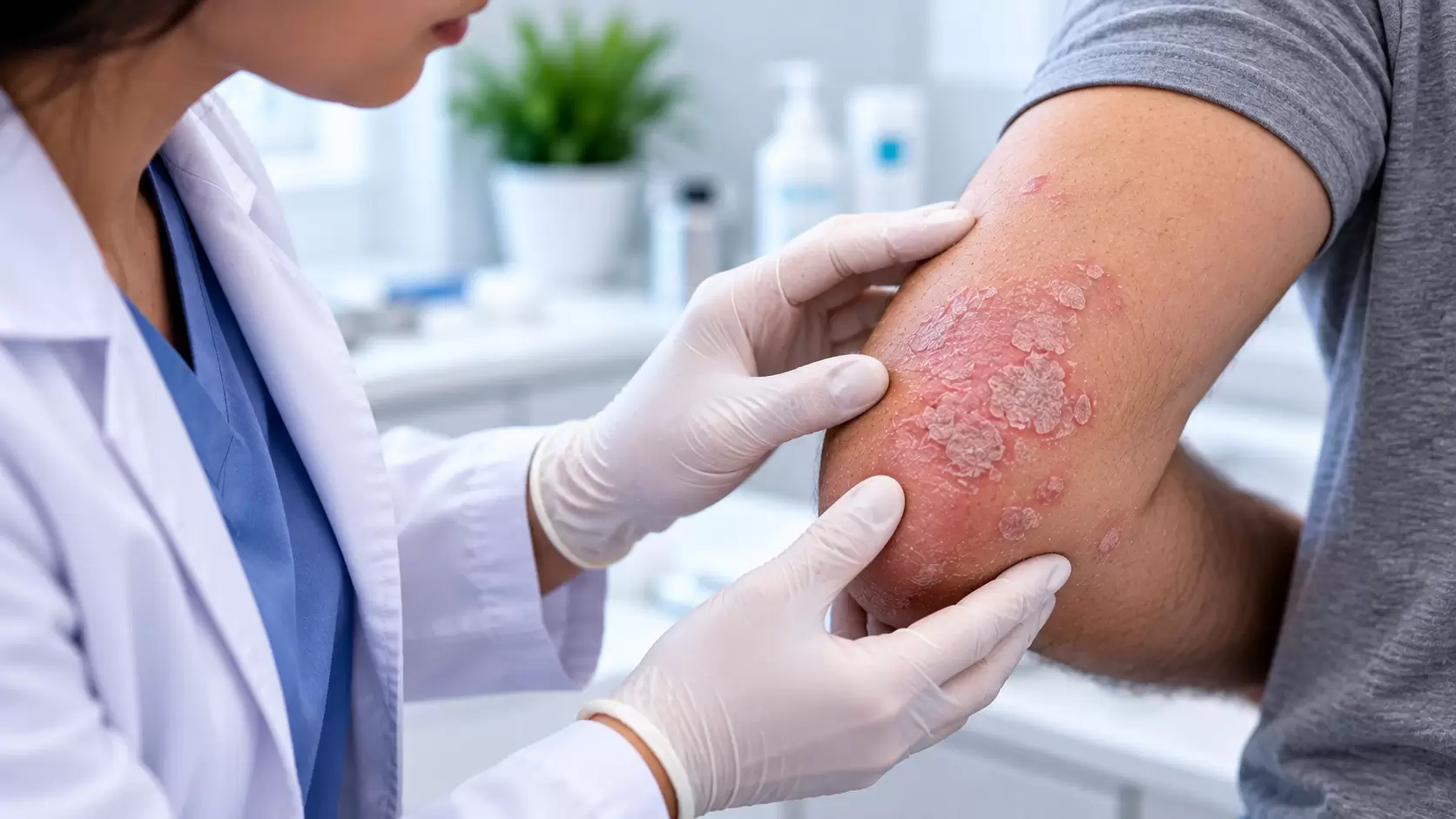
What can psoriasis look like at the beginning?
Psoriasis is a chronic inflammatory skin condition, but the first visible signs are not identical for everyone. Plaque psoriasis commonly produces well-defined areas of inflamed skin with scale. On lighter skin these may look pink or red; on darker skin, plaques may appear violet, grey, brown or darker than the surrounding skin, and colour changes can remain after a flare settles.
The first area may be small and easy to overlook. Some people initially notice persistent scalp scaling, a patch over an elbow or knee, or changes in their fingernails. Others develop many small spots more suddenly, as can occur with guttate psoriasis.
For a broader explanation of why psoriasis develops and its different forms, read Psoriasis Causes, Symptoms & Types.
Common early warning signs
Persistent scaly patches
A patch that is clearly outlined, repeatedly becomes scaly and does not behave like ordinary dry skin can be an early clue. Classic plaques commonly affect the elbows, knees, scalp and lower back.
Itching or soreness
Psoriasis may itch, burn or feel sore. Scratching can thicken irritated skin and may worsen symptoms, particularly when psoriasis affects the scalp.
Scalp flaking
Scalp psoriasis may initially resemble dandruff, but it can produce thicker, drier scale and well-defined patches. It may extend beyond the hairline or appear behind the ears.
Nail changes
Small pits in the nail surface, thickening, discolouration or separation of the nail from the nail bed can occur with psoriasis. Nail changes deserve assessment, particularly when accompanied by skin or joint symptoms.
Cracks in thickened skin
Psoriasis on the palms or soles can become thick and develop painful fissures. Persistent cracking should not automatically be assumed to be simple dryness.
Small widespread spots
Guttate psoriasis can cause a sudden eruption of numerous small scaly lesions, often on the trunk and limbs. It can follow a streptococcal throat infection, especially in younger people.
Where do the first signs commonly appear?
Psoriasis can affect almost any skin surface. Common sites include the scalp, elbows, knees and lower back. It can also involve body folds, palms, soles, genitals and nails. The appearance depends partly on the type and location.
Scalp involvement can also be subtle initially. Flaking that repeatedly returns despite routine dandruff care, especially when accompanied by thicker plaques elsewhere, warrants a closer look.
Psoriasis or just dry skin?
Ordinary dry skin is extremely common and does not mean you have psoriasis. Psoriasis becomes more likely when patches are persistent or recurrent, have relatively clear borders, develop characteristic scale, occur at typical sites, or are accompanied by nail changes or a personal or family history of psoriasis.
Other conditions—including eczema, fungal infections and seborrhoeic dermatitis—can resemble psoriasis. A dermatologist can often diagnose psoriasis by examining the skin, scalp and nails; occasionally a skin biopsy is used when the diagnosis is uncertain.
If you already know you have psoriasis and want to understand what can make it worsen, our next guide will cover psoriasis triggers and flare-ups.
Do joint symptoms matter?
Yes. Psoriasis is not limited to the skin. Some people develop psoriatic arthritis. Tell your doctor if psoriasis or suspected psoriasis is accompanied by recurring joint pain, swelling or stiffness, particularly morning stiffness. Early recognition of inflammatory joint disease is important.
The American Academy of Dermatology notes that dermatologists can monitor people with psoriasis for early signs of psoriatic arthritis. The NHS likewise advises medical review when psoriasis occurs with recurring joint pain, stiffness or swelling.
When should you see a dermatologist?
Arrange an assessment if you have persistent, recurring or unexplained scaly patches; troublesome scalp symptoms; nail changes; or a rash that is not improving with ordinary skin care. An examination is particularly useful when the appearance overlaps with eczema, fungal infection or another inflammatory skin condition.
At Ram Skin Clinic, assessment can include the distribution and appearance of the rash, scalp and nail examination, symptoms and triggers, family history and, where appropriate, evaluation for joint symptoms. Learn about our psoriasis treatment in Chennai service.
Frequently asked questions
What is usually the first sign of psoriasis?
There is no single first sign for everyone. A persistent, clearly defined scaly patch is common, while some people first notice scalp scaling, small guttate spots or nail changes.
Can psoriasis start as one small patch?
Yes. Psoriasis can initially be localised. A small persistent patch may later remain limited or additional areas may develop.
Can early psoriasis look like dandruff?
Scalp psoriasis can resemble dandruff, particularly when mild. Psoriasis tends to produce more defined patches and may have thicker, drier scale or occur elsewhere on the body.
Does psoriasis always itch?
No. Itch varies considerably. Some people have little itching, while others experience significant itching, burning or soreness.
Can psoriasis affect the nails before the skin?
Nail psoriasis can be an important clue. Pitting, thickening, discolouration or nail separation should be assessed, especially if psoriasis or psoriatic arthritis is suspected.
Is psoriasis contagious?
No. Psoriasis is an immune-mediated inflammatory condition and cannot be caught from or spread to another person through contact.
For authoritative patient information, see the American Academy of Dermatology, DermNet and NHS.
Visit us in OMR
Noticed possible signs of psoriasis?
Book a dermatologist consultation at Ram Skin Clinic in Thoraipakkam, Chennai.
#48, Second Floor, Flat E, Best Towers,Okkiampet, Thoraipakkam, OMR,
Chennai – 600097. Above Domino’s Pizza.