
Acne-Like Bumps Explained
Folliculitis vs Acne: How to Tell the Difference
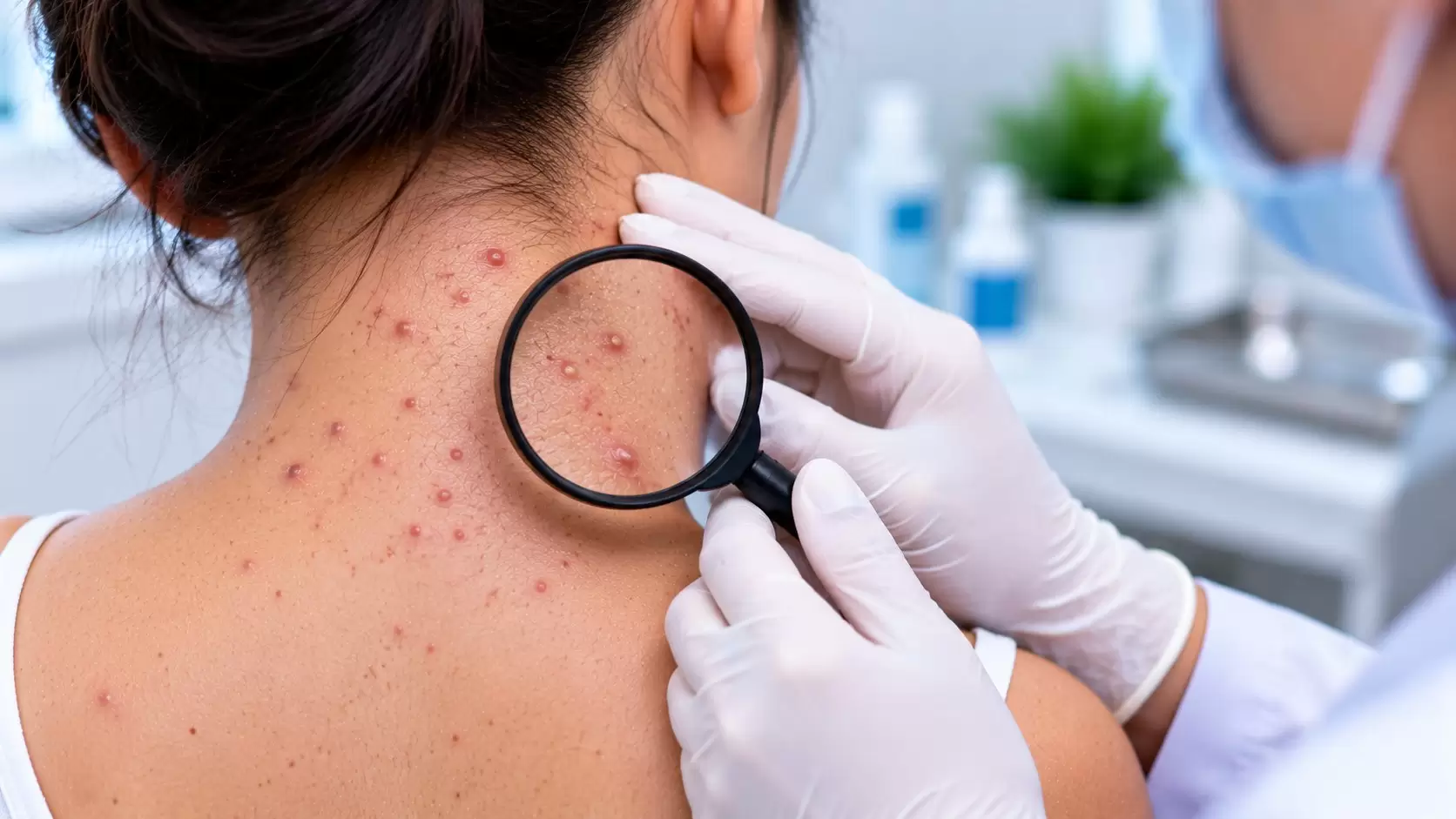
Folliculitis and acne can both cause red bumps and pustules, but they are not the same condition. Blackheads and whiteheads strongly support acne, while itchy or tender pustules centred closely around individual hairs can suggest folliculitis.
Why are folliculitis and acne easy to confuse?
Both conditions involve the follicular unit and can create red papules and pus-filled bumps. Mayo Clinic notes that folliculitis may initially look like small pimples around hair follicles. Acne can also cause inflammatory papules and pustules, so appearance can overlap.
The distinction becomes clearer when you look at the full pattern: the types of lesions present, whether comedones exist, how itchy the eruption is, where it occurs, how suddenly it appeared and what triggered it.
Folliculitis vs acne: key differences
| Feature | Folliculitis | Acne |
|---|---|---|
| Main process | Inflammation of hair follicles from infectious or non-infectious causes | Chronic inflammatory disorder of the pilosebaceous unit with follicular plugging and sebum involvement |
| Blackheads / whiteheads | Usually absent | Common and diagnostically useful |
| Pustules | Common and often centred on individual follicles | Common in inflammatory acne |
| Itching | Can be prominent, especially Malassezia folliculitis | Usually less prominent than in itchy folliculitis |
| Lesion variety | Some forms produce many similar-looking lesions | Often a mixture of comedones, papules, pustules and sometimes nodules |
| Typical sites | Any hair-bearing skin; depends on the type and trigger | Face, neck, chest and back are common |
The biggest clue: comedones
DermNet describes open and closed comedones—blackheads and whiteheads—as characteristic acne lesions. Acne often combines these non-inflammatory lesions with papules, pustules and sometimes deeper nodules.
By contrast, folliculitis generally does not produce true comedones. Malassezia folliculitis is particularly known for uniform itchy papules and pustules without comedones.
What does folliculitis usually look like?
Folliculitis commonly produces clusters of small bumps or pustules around hair follicles. Mayo Clinic lists itching, burning, tenderness and crusting among possible symptoms.
Bacterial folliculitis
Often produces tender or itchy pustules around follicles and is frequently associated with Staphylococcus aureus.
Malassezia folliculitis
Typically produces many small, uniform and itchy follicular papules or pustules, often on the upper chest, back or hairline.
Hot-tub folliculitis
Can appear after exposure to inadequately maintained hot tubs or heated pools and often causes an itchy follicular eruption.
Shaving-related bumps
Shaving can cause true folliculitis or pseudofolliculitis from ingrown hairs, particularly in beard and neck areas.
Read Folliculitis Causes & Symptoms for the complete overview.
What does acne usually look like?
DermNet describes acne as a combination of open and closed comedones, inflammatory papules and pustules, and—in more severe cases—nodules or pseudocysts. Acne commonly affects the face and may extend to the neck, chest and back.
Because several lesion types often coexist, acne usually looks less uniform than Malassezia folliculitis. Acne may also leave post-inflammatory marks and scars.
For treatment information, see Acne Treatment in Chennai.
Does itching mean it is folliculitis?
Not automatically, but prominent itch can be a useful clue. Malassezia folliculitis is characteristically itchy, and bacterial folliculitis can also itch or burn. Acne may occasionally itch, particularly when irritated, but itch is not usually its defining feature.
Very itchy, uniform bumps across the upper chest, back, forehead or hairline—especially without blackheads or whiteheads—should raise the possibility of Malassezia folliculitis. See Bacterial vs Fungal Folliculitis.
Triggers can provide important clues
Folliculitis clues
A sudden eruption after shaving, waxing, sweating, tight clothing, occlusive products, hot-tub exposure or certain medicines may suggest folliculitis.
Acne clues
Acne often has a longer-term pattern influenced by sebum production, follicular plugging, hormones, genetics, some medicines and occlusive cosmetics.
Can you have acne and folliculitis at the same time?
Yes. The two can coexist. This can make self-diagnosis particularly difficult because an area may contain genuine acne comedones alongside a separate follicular eruption.
Gram-negative folliculitis is one example that can be mistaken for worsening acne and may occur in people receiving prolonged antibiotic therapy for acne. Malassezia folliculitis can also be confused with acne on the chest, back and forehead.
Why the correct diagnosis matters
Acne treatment aims at processes such as follicular plugging, inflammation and sebum-related factors. Folliculitis treatment depends on its cause: bacterial, yeast-related, viral, irritant, occlusive or another form.
Using the wrong treatment can therefore produce little improvement. For example, antibiotics do not treat Malassezia folliculitis, while antifungal therapy is not a treatment for ordinary acne.
How a dermatologist can confirm the diagnosis
Often the diagnosis can be made from the distribution and appearance of the lesions plus the history. When folliculitis persists or the cause is uncertain, Mayo Clinic notes that evaluation can include skin scraping for yeast, a swab for culture and, rarely, a skin biopsy to exclude other conditions.
Testing is particularly useful when an acne-like eruption has not responded as expected to conventional acne treatment.
When should you see a dermatologist?
Arrange assessment if you cannot tell whether the eruption is acne or folliculitis, it keeps recurring, is widespread, becomes painful, is very itchy, leaves scars or marks, or does not respond to appropriate treatment.
For assessment, visit Folliculitis Treatment in Chennai.
Frequently asked questions
What is the easiest way to tell folliculitis from acne?
Blackheads and whiteheads strongly support acne. Folliculitis more often produces follicle-centred pustules or bumps without comedones, although a dermatologist may be needed when the appearance overlaps.
Can folliculitis look exactly like pimples?
Yes. Folliculitis commonly causes acne-like bumps and pustules, which is why it can be mistaken for acne.
Does folliculitis have blackheads?
True comedones are not a typical feature of folliculitis. Blackheads and whiteheads are characteristic lesions of acne.
Is itchy acne actually folliculitis?
Not necessarily. However, intense itch with many uniform bumps, especially on the chest, back or hairline and without comedones, can suggest Malassezia folliculitis.
Can acne antibiotics cause folliculitis?
Long-term antibiotic treatment for acne is associated with some forms of folliculitis, including gram-negative folliculitis, and antibiotic exposure is also a recognised risk factor for Malassezia folliculitis.
Can a dermatologist test folliculitis?
Yes. When needed, testing can include bacterial culture, scraping for yeast or fungi and occasionally skin biopsy.
For authoritative information, see DermNet on acne vulgaris, DermNet on folliculitis and Mayo Clinic.
Visit us in OMR
Acne or folliculitis? Get the right diagnosis.
Book a dermatologist consultation at Ram Skin Clinic in Thoraipakkam, Chennai.
#48, Second Floor, Flat E, Best Towers,Okkiampet, Thoraipakkam, OMR,
Chennai – 600097. Above Domino’s Pizza.