
Platelet-Derived Treatments for Hair Loss
GFC vs PRP for Hair Loss: What Is the Difference?
GFC and PRP are both autologous procedures made from a patient’s own blood and used in selected cases of hair thinning. They share a biological rationale, but their preparation methods and the material injected into the scalp are not identical.
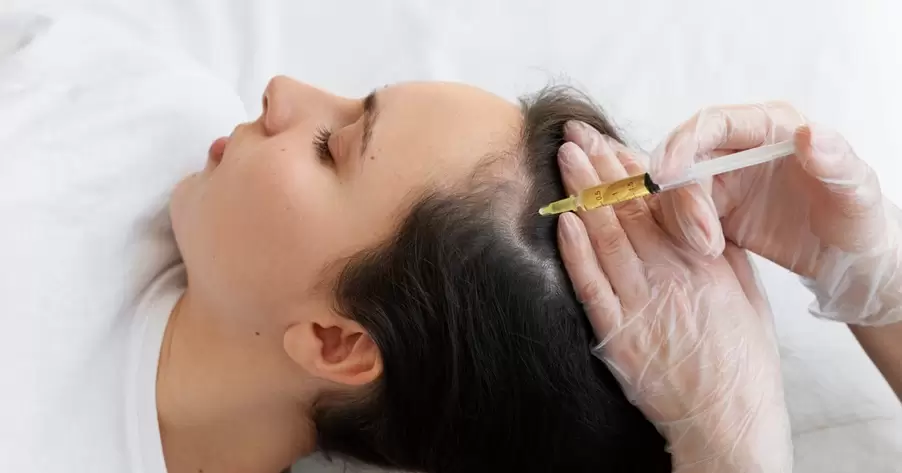
First, what do GFC and PRP have in common?
Both treatments begin with a sample of the patient’s own blood. The sample is processed and an autologous preparation is injected into selected areas of the scalp. Both are intended to expose viable hair follicles to platelet-derived biological signals.
Neither procedure creates new follicles where follicles have been permanently lost. They are generally considered for patients who still have functioning or miniaturised follicles, particularly in androgenetic alopecia.
For the fundamentals of GFC, read What Is GFC Hair Treatment? and How Does GFC Treatment Work for Hair Loss?.
GFC vs PRP: at a glance
| Feature | GFC | PRP |
|---|---|---|
| Source | Patient’s own blood | Patient’s own blood |
| Preparation goal | Obtain a concentrate rich in platelet-derived growth factors | Obtain plasma with an increased platelet concentration |
| Material delivered | Processed growth-factor concentrate | Platelet-rich plasma |
| Main clinical use in hair loss | Selected patients with viable follicles, especially pattern thinning | Selected patients with viable follicles, especially pattern thinning |
| Evidence base | Growing but comparatively smaller and protocol-dependent | Larger body of published hair-loss literature, though protocols remain heterogeneous |
How is PRP prepared?
In conventional PRP treatment, blood is centrifuged to separate components and produce plasma with a platelet concentration above baseline whole blood. The final composition depends on the collection system, centrifugation protocol and whether leukocytes and other components are retained.
After preparation, the PRP is injected into the scalp. Platelets then release signalling proteins that form the biological rationale for treatment.
How is GFC different?
GFC systems are designed to obtain growth factors released from platelets in a processed concentrate. Instead of describing the final material simply as platelet-rich plasma, the emphasis is on the growth-factor fraction produced by the preparation protocol.
This distinction is important because “PRP” and “GFC” are not merely two marketing names for exactly the same preparation. The devices, processing methods and final biological products can differ.
Do GFC and PRP work through the same general pathway?
They overlap biologically because both are platelet-derived approaches. Platelets contain signalling proteins such as platelet-derived growth factor and vascular endothelial growth factor. These mediators are involved in cellular communication, tissue repair and vascular biology.
For hair loss, the aim is to influence the environment of existing follicles. The treatment does not change a person’s genetics or permanently remove the hormonal susceptibility responsible for androgenetic alopecia.
Which treatment has more research?
PRP has a larger published evidence base for androgenetic alopecia. Systematic reviews and meta-analyses have reported improvements in hair-density outcomes in some patients, while also highlighting substantial variation in PRP preparation, injection schedules and study quality.
Clinical evidence for concentrated growth-factor preparations is growing, including comparative studies with PRP, but it remains less extensive. Because GFC systems can also differ, results from one protocol should not automatically be assumed for every preparation.
Is GFC more effective than PRP?
Current research does not justify promising that one will outperform the other for every patient. Some comparative studies report favourable outcomes with both treatments, and individual trials may show differences in specific measurements or time points.
However, differences in preparation systems, patient selection, concurrent therapies and outcome measurement make simple head-to-head claims difficult. Treatment decisions should therefore be based on the individual case rather than an absolute claim that one procedure is always superior.
What about treatment comfort?
Both procedures require blood collection and multiple small scalp injections. Injection discomfort, tenderness, temporary redness, pinpoint bleeding or mild swelling can occur with either treatment.
Experience can vary according to injection technique, number of injection points, scalp sensitivity and the protocol being used.
How many sessions are required?
There is no universally standardised session schedule for either GFC or PRP. Many published protocols use an initial series of treatments separated by several weeks, followed by reassessment.
The number of sessions should not be selected solely from a package advertised online. The underlying diagnosis, degree of miniaturisation, response and other ongoing hair-loss treatments matter.
Which works faster: GFC or PRP?
Neither produces instant visible regrowth because hair follicles cycle over months. Even when a follicle responds biologically, new hair needs time to progress through the growth phase before visible changes in density or thickness can be assessed.
Standardised clinical photographs and, when appropriate, trichoscopic assessment provide a more useful comparison than checking the scalp from day to day.
Can either treatment restore a completely bald area?
Neither GFC nor PRP reliably recreates follicles that have been permanently lost. A longstanding smooth bald area is biologically different from an area containing miniaturised hairs.
This is one reason dermatologist assessment before treatment matters: the clinician can determine whether viable follicles remain and whether an injection-based procedure is a reasonable option.
Do GFC or PRP replace medical hair-loss treatment?
Not necessarily. Androgenetic alopecia is progressive. Dermatologist-directed medical treatment may still be important, and platelet-derived procedures can be considered as adjuncts in selected patients.
Hair shedding can also result from nutritional deficiency, thyroid disease, recent illness, medications, scalp inflammation and other conditions. Those causes require appropriate evaluation rather than automatically choosing GFC or PRP.
See Hair Loss Treatment Options for a broader overview.
How does a dermatologist choose between GFC and PRP?
The decision can take into account the type and stage of hair loss, follicle viability, scalp condition, medical history, previous treatment, available preparation system and the patient’s expectations.
The key question is not simply “Which injection is better?” but whether a platelet-derived procedure is appropriate for the diagnosed cause of hair loss in the first place.
For clinic-specific information, visit GFC Hair Treatment in Chennai.
Frequently asked questions
Is GFC the same as PRP?
No. Both are prepared from the patient’s blood, but PRP aims to concentrate platelets in plasma, while GFC systems are designed to produce a concentrate rich in growth factors released from platelets.
Is GFC better than PRP for hair loss?
Current evidence does not establish that one treatment is universally superior for every patient. Comparative outcomes depend on preparation protocol, diagnosis, patient selection and other treatments being used.
Which has more evidence, GFC or PRP?
PRP currently has a larger published evidence base in androgenetic alopecia. Research on concentrated growth-factor preparations is growing but is comparatively smaller.
Are GFC and PRP permanent treatments?
No. Neither removes the underlying genetic tendency of pattern hair loss, and maintenance or other medical treatment may still be required.
Can I choose GFC or PRP without a hair-loss diagnosis?
A dermatologist assessment is preferable because different causes of hair loss require different treatment. An injection procedure may be inappropriate if the underlying problem is infection, scarring alopecia, nutritional deficiency or another condition.
Hair loss treatment in OMR, Chennai
GFC or PRP? Start with the diagnosis, not the procedure.
Book a dermatologist consultation at Ram Skin Clinic in Thoraipakkam, Chennai.
#48, Second Floor, Flat E, Best Towers,Okkiampet, Thoraipakkam, OMR,
Chennai – 600097. Above Domino’s Pizza.