
Understanding Growth Factor Concentrate
How Does GFC Treatment Work for Hair Loss?
GFC hair treatment uses an autologous concentrate prepared from the patient’s own blood. The aim is to deliver platelet-derived growth factors directly to areas of the scalp where viable hair follicles are thinning.
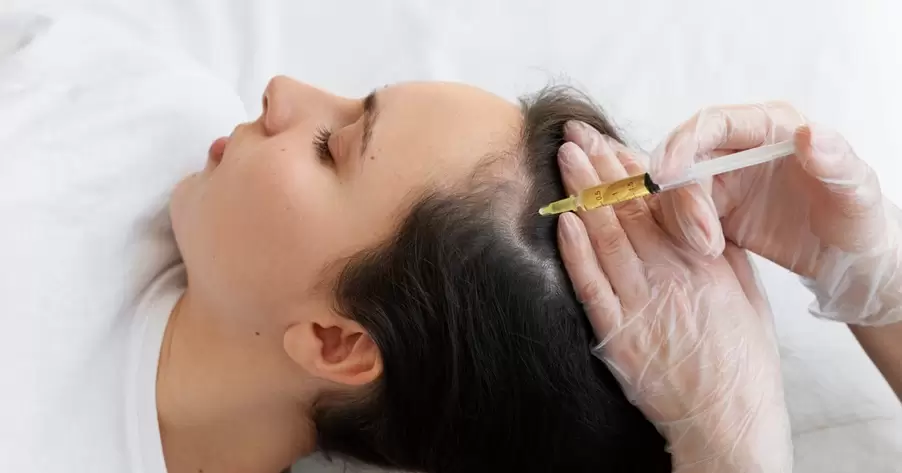
GFC starts with your own blood
GFC is an autologous procedure, meaning the biological material used for treatment comes from the patient. A blood sample is collected and processed using a dedicated preparation system to obtain a concentrate containing growth factors released from platelets.
The concentrate is then delivered into the scalp rather than being applied only to the surface. If you are new to the treatment, first read What Is GFC Hair Treatment?.
How GFC works: step by step
1. Blood collection
A small venous blood sample is collected under appropriate sterile conditions.
2. Controlled processing
The sample is processed according to the GFC preparation system so that platelet-derived growth factors can be separated and concentrated.
3. Scalp mapping
The dermatologist identifies the areas of thinning where viable follicles may benefit from treatment.
4. Intradermal delivery
Small amounts of the prepared concentrate are injected across the planned treatment area so the growth factors are delivered near the follicles.
What are growth factors and why do they matter?
Growth factors are signalling proteins involved in communication between cells. Platelets contain several of these proteins, including platelet-derived growth factor and vascular endothelial growth factor. Their biological roles include signalling related to tissue repair, vascular activity and cellular behaviour.
That biology provides the rationale for platelet-derived treatments in hair loss. The goal is not to insert new follicles. Instead, treatment is directed at an existing follicular environment where miniaturised but viable follicles remain.
What happens to hair in androgenetic alopecia?
Pattern hair loss is characterised by progressive follicular miniaturisation. Over successive growth cycles, susceptible follicles produce finer and shorter hairs. Eventually some follicles may become so miniaturised that visible coverage is markedly reduced.
This explains why timing matters. GFC is biologically more plausible where follicles are still present than in smooth areas where follicles have been permanently lost.
What does the clinical evidence show?
Clinical research on autologous growth-factor injections is developing. Studies have reported improvements in measures such as hair density and thickness in some patients with androgenetic alopecia, but study sizes, preparation techniques and treatment protocols differ.
A recent systematic review and meta-analysis of growth-factor injections found encouraging improvements but also highlighted substantial heterogeneity and significant risk of bias in the available evidence. This means the treatment should be presented as a promising option rather than a guaranteed method of regrowth.
Why doesn’t GFC work instantly?
Hair follicles operate in a biological cycle. Even if treatment favourably influences a follicle, visible changes take time because new hair must enter and progress through its growth phase before increased length or density becomes noticeable.
This is why photographs and trichoscopic assessment taken at consistent intervals are more meaningful than judging the scalp immediately after treatment.
Can GFC make thin hairs thicker?
One treatment goal in pattern hair loss is to improve the performance of miniaturised follicles that are still capable of producing hair. Some clinical studies of concentrated growth-factor approaches have reported improvements in hair density and shaft-related measurements.
Individual response is variable, however. The extent of miniaturisation, duration of hair loss, age, underlying diagnosis and simultaneous medical treatment can all affect the outcome.
Why multiple sessions may be recommended
GFC is generally performed as a treatment course rather than assuming that one injection session will provide a complete result. Published protocols vary, but several studies have used multiple sessions spaced roughly a month apart.
The number and interval used clinically should be individualised rather than copied automatically from a study or online treatment package.
Does GFC work for every type of hair loss?
No. Hair loss is a broad symptom with many causes. Androgenetic alopecia, telogen effluvium, alopecia areata, scarring alopecia, fungal infection and hair loss related to nutritional or systemic conditions have different mechanisms.
GFC should therefore follow diagnosis rather than replace it. For an overview of other approaches, see Hair Loss Treatment Options.
Can GFC replace minoxidil or other hair-loss treatment?
Not automatically. Pattern hair loss is progressive, and dermatologist-directed medical treatment may still be important. Procedural therapies can be used as adjuncts in selected patients.
A 2026 randomised study comparing GFC and PRP as adjuncts to topical minoxidil found improvement in both treatment groups, illustrating that GFC may be incorporated into a combined treatment strategy rather than viewed only as a stand-alone intervention.
GFC versus PRP: is the mechanism identical?
Both begin with autologous blood and belong to the broader family of platelet-derived regenerative procedures, but the preparation and final material are not identical. Conventional PRP aims to concentrate platelets in plasma, whereas GFC systems are designed to obtain a preparation rich in growth factors released from platelets.
Because preparation methods vary, claims about one product should not automatically be transferred to every other platelet-derived preparation.
Who is more likely to be a reasonable candidate?
Potential candidates generally need viable follicles in the treatment area and a diagnosis for which a platelet-derived procedure is considered appropriate. Earlier pattern thinning may offer a different biological opportunity than longstanding smooth baldness.
A scalp examination also helps identify inflammation, infection or signs of scarring alopecia that may require a different treatment pathway.
Why diagnosis matters before the first injection
A procedure can only address the problem it is designed for. If shedding is being driven by iron deficiency, thyroid dysfunction, recent illness, medication, severe dietary restriction or another scalp disorder, those factors may need investigation and treatment.
At Ram Skin Clinic, GFC can be considered after assessing the pattern of hair loss, scalp condition, history and realistic treatment goals. See the main GFC Hair Treatment in Chennai page for treatment information.
Frequently asked questions
How does GFC work for hair loss?
GFC uses growth factors obtained from the patient’s own blood and delivers them into selected scalp areas. The treatment is intended to support the biological environment of viable hair follicles.
Does GFC create new hair follicles?
No. GFC is intended to work with follicles that are still present. It cannot reliably recreate follicles that have been permanently lost.
How long does GFC take to work?
Hair growth is slow, so visible assessment generally requires months rather than days or weeks. Response and timing vary between patients.
Why are several GFC sessions used?
Clinical protocols commonly use a series of treatments because hair follicles cycle over time. The appropriate schedule should be decided according to the individual patient and treatment protocol.
Is GFC scientifically proven for hair loss?
Clinical studies report promising improvements in androgenetic alopecia, but the evidence remains limited by variable protocols, relatively small studies and differences between growth-factor preparations. Results cannot be guaranteed.
GFC hair treatment in OMR, Chennai
Hair thinning? Find out whether your follicles are suitable for GFC.
Book a dermatologist consultation at Ram Skin Clinic in Thoraipakkam, Chennai.
#48, Second Floor, Flat E, Best Towers,Okkiampet, Thoraipakkam, OMR,
Chennai – 600097. Above Domino’s Pizza.