
Growth Factor Concentrate for Hair Loss
What Is GFC Hair Treatment? How It Works, Uses, Procedure and Results
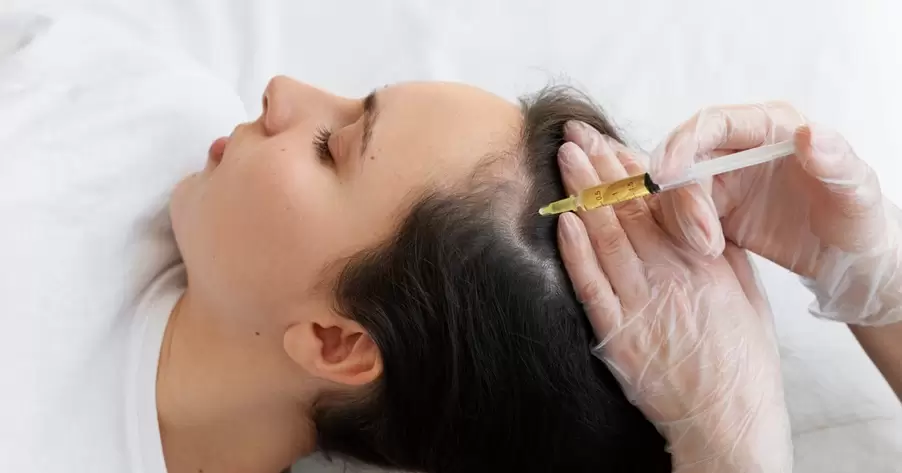
GFC, or Growth Factor Concentrate, is an autologous hair-loss procedure in which a small blood sample is processed to prepare a concentrated growth-factor-rich solution that is delivered into selected areas of the scalp.
What does GFC mean?
GFC stands for Growth Factor Concentrate. It is prepared from the patient’s own blood and is designed to concentrate platelet-derived signalling proteins while reducing some of the cellular components present in whole blood.
In hair-loss practice, the prepared concentrate is delivered into the scalp in selected patients. The rationale is to expose functioning hair follicles to growth-factor signals that may support follicular activity and the hair-growth cycle.
GFC should not be viewed as a universal treatment for every type of hair loss. Diagnosis comes first. Visit our GFC Hair Treatment in Chennai page for the clinic treatment overview.
How is GFC prepared?
1. Blood collection
A small amount of the patient’s own blood is collected under sterile conditions.
2. Processing
The sample is placed into the designated preparation system and processed according to its protocol.
3. Growth-factor concentrate
The process yields an autologous concentrate containing platelet-derived growth factors rather than using an externally sourced growth-factor product.
4. Scalp delivery
The prepared solution is administered into the targeted scalp areas using multiple small injections.
How may growth factors support hair follicles?
Platelets contain signalling proteins involved in tissue repair and cellular communication. Platelet-derived growth factor, vascular endothelial growth factor and other mediators have biological roles that provide the rationale for platelet-derived therapies in hair loss.
Most published clinical evidence in this broader treatment category concerns platelet-rich plasma (PRP). Reviews of PRP for androgenetic alopecia report potential improvements in measures such as hair density, but preparation methods and treatment protocols vary considerably between studies. GFC is a related autologous platelet-derived approach, but it should not be assumed that every PRP study directly proves an identical effect for every GFC preparation.
Which type of hair loss is GFC commonly considered for?
Platelet-derived treatments are most often discussed for androgenetic alopecia—pattern hair loss—in patients who still have functioning follicles. A dermatologist may also consider procedural treatment as part of a broader plan in selected cases of thinning, depending on the diagnosis.
For a broader overview, see Hair Loss Treatment Options.
Can GFC regrow hair on a completely bald scalp?
GFC is intended to work with existing follicles. It cannot reliably recreate follicles that have been permanently lost. This distinction is important in advanced pattern baldness where areas may have been smooth and hairless for a long time.
Earlier thinning with miniaturised but viable follicles is biologically different from established follicular loss. A scalp examination helps determine whether a regenerative procedure is a reasonable option.
What happens during a GFC hair treatment session?
The appointment generally includes scalp assessment, blood collection, preparation of the concentrate and a series of injections into the planned treatment zones. Exact technique, volume and spacing vary according to the system and clinical protocol.
Patients can experience brief discomfort from the injections. The scalp may feel tender afterwards, and small injection-site marks can occur temporarily.
How many GFC sessions are needed?
There is no single schedule appropriate for every patient. Treatment protocols commonly use an initial series of sessions separated by several weeks, followed by reassessment. Maintenance may be discussed according to the underlying hair-loss condition and response.
Because hair grows slowly, meaningful assessment should not be based on what the scalp looks like a few days after treatment. Standardised photographs and follow-up examination are more useful than day-to-day visual checking.
When can you expect results?
Hair follicles cycle over months, so procedural hair-loss treatments do not produce instant visible regrowth. Early changes may involve reduced shedding in some patients, while changes in density or thickness require longer observation.
Response varies. Age, duration and severity of hair loss, follicle miniaturisation, underlying medical factors and simultaneous treatments can all influence outcome.
GFC is usually part of a treatment plan
Pattern hair loss is a progressive condition. A procedural treatment may be used alongside dermatologist-recommended medical therapy when appropriate rather than automatically replacing established treatment.
Hair loss can also have contributing factors such as iron deficiency, thyroid disease, recent illness, rapid weight change or scalp disease. These require appropriate evaluation rather than repeated injections alone.
GFC versus PRP
Both approaches are autologous and begin with the patient’s blood, but their preparation methods differ. Conventional PRP aims to produce plasma with an increased platelet concentration, whereas GFC systems are designed to obtain a concentrate of growth factors released from platelets.
These terms should not be treated as interchangeable. The preparation system, final product and clinical protocol matter.
What are the possible side effects?
Because GFC is derived from the patient’s own blood, allergic reaction to the concentrate itself is not the main concern. However, the procedure still involves blood collection and multiple scalp injections.
Pain or tenderness
Temporary injection discomfort and scalp tenderness can occur.
Redness or swelling
Mild local redness or swelling may occur around injection sites.
Bruising or pinpoint bleeding
Small areas of bleeding or bruising are possible because needles are used.
Infection
Infection is uncommon when sterile technique is used but remains a potential complication of any injection procedure.
Who may not be an ideal candidate?
Suitability depends on medical history, diagnosis and scalp examination. Active scalp infection or inflammation may need treatment first. Blood or platelet disorders, medications that affect clotting and other medical conditions should be disclosed during consultation.
Patients with advanced permanent follicular loss also need realistic counselling because injections cannot restore absent follicles.
Why dermatologist assessment matters before GFC
“Hair fall” is a symptom, not a diagnosis. Pattern hair loss, telogen effluvium, alopecia areata, fungal infection and scarring alopecia require different approaches. Starting a procedural treatment without identifying the cause can delay appropriate management.
At Ram Skin Clinic, the treatment decision can be based on the pattern of loss, scalp findings, history and whether additional investigation is indicated.
Frequently asked questions
What is GFC hair treatment?
GFC, or Growth Factor Concentrate, is an autologous procedure in which a patient’s blood is processed to prepare a growth-factor-rich concentrate that is delivered into selected areas of the scalp.
Is GFC the same as PRP?
No. Both originate from the patient’s blood, but their preparation methods and final products differ.
Does GFC permanently cure hair loss?
No procedure should be described as a guaranteed permanent cure for pattern hair loss. Ongoing medical or maintenance treatment may be needed.
How quickly does GFC work?
Hair growth occurs slowly over months. Response should be assessed over an appropriate follow-up period rather than immediately after a treatment session.
Can GFC work if I am completely bald?
GFC depends on viable follicles and cannot reliably create new follicles where they have been permanently lost.
Hair loss assessment in OMR, Chennai
Considering GFC? Start by identifying the cause of your hair loss.
Book a dermatologist consultation at Ram Skin Clinic in Thoraipakkam, Chennai.
#48, Second Floor, Flat E, Best Towers,Okkiampet, Thoraipakkam, OMR,
Chennai – 600097. Above Domino’s Pizza.