
Understanding Uneven Facial Colour
Facial Pigmentation Causes: Why Dark Patches Appear on the Face
Dark patches on the cheeks, forehead, upper lip or other facial areas can have several causes. Melasma is common, but acne, dermatitis, sun exposure, irritation and medicines can produce similar-looking pigmentation.
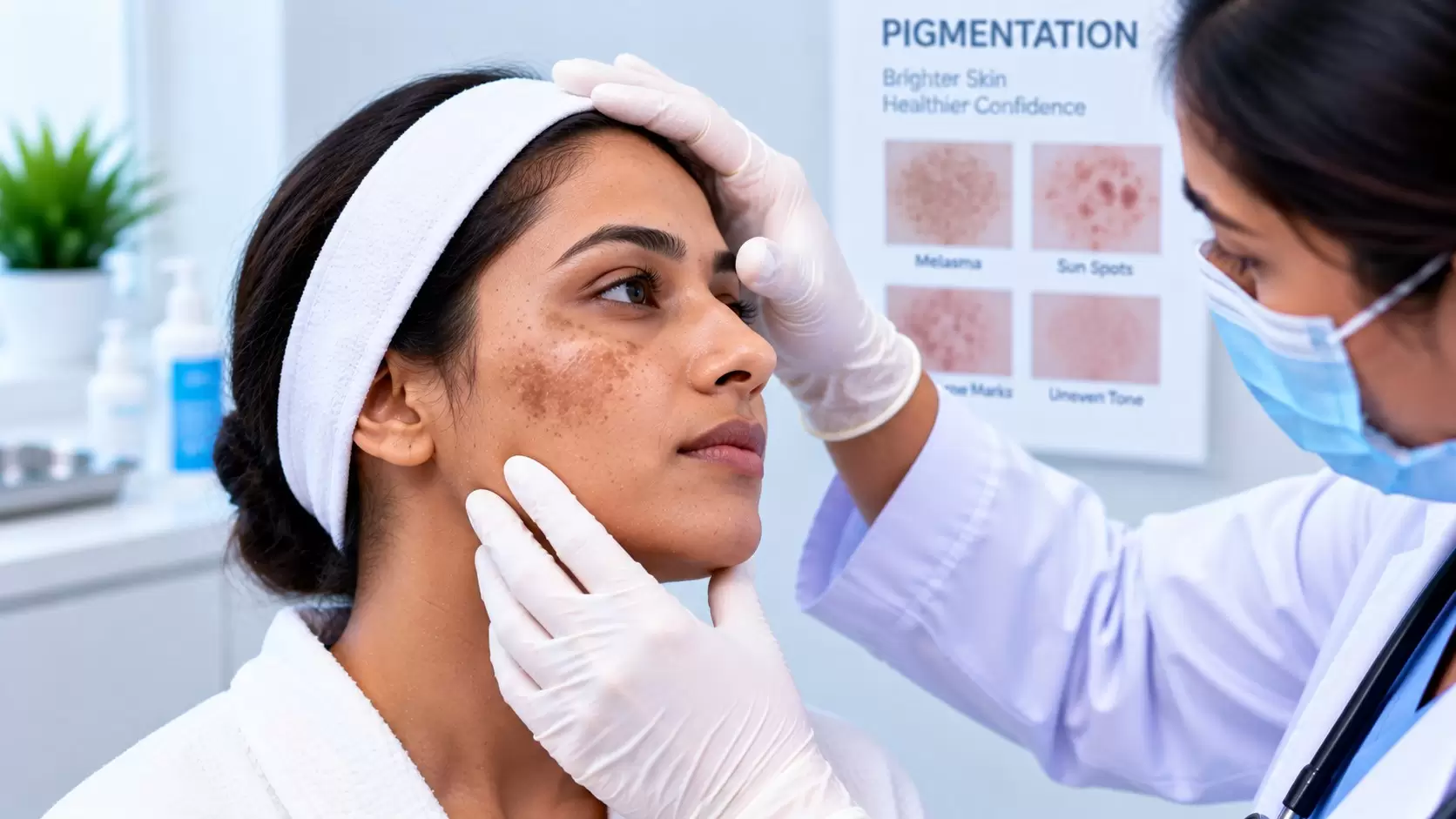
Why does facial skin become darker?
Melanin is the main pigment responsible for skin colour. Facial skin can become darker when melanocytes produce extra melanin after light exposure, hormonal stimulation, inflammation or injury.
The face is particularly prone to pigmentation because it receives frequent light exposure and is also exposed to acne, cosmetics, skin-care products and procedures.
Common causes of facial pigmentation
Melasma
Usually causes bilateral blotchy brown or grey-brown patches, commonly on the cheeks, forehead, nose, upper lip and chin.
Acne marks
Inflamed pimples can leave flat brown or grey-brown post-inflammatory marks after the acne itself heals.
Sun-related pigmentation
Ultraviolet exposure stimulates melanin and can create or darken uneven pigmentation and lentigines.
Dermatitis & irritation
Eczema, allergic or irritant reactions, rubbing and harsh products can leave pigmentation after inflammation settles.
1. Melasma on the face
Melasma is a common acquired pigmentary disorder. It usually appears as blotchy, relatively symmetrical facial pigmentation, often involving both cheeks, the forehead, nose, upper lip or chin.
Sunlight and visible light can worsen melasma. Hormonal influences, including pregnancy and some hormonal medicines, and genetic susceptibility can also contribute.
See Hyperpigmentation vs Melasma for a detailed comparison.
2. Acne and post-inflammatory marks
When an acne lesion becomes inflamed, melanocytes can produce extra pigment during healing. The pimple may disappear while a flat dark mark remains.
This is post-inflammatory hyperpigmentation rather than necessarily an acne scar. True scars alter the texture of the skin; PIH primarily changes colour.
Learn more in Post-Inflammatory Hyperpigmentation.
3. Sun exposure and uneven facial colour
Ultraviolet radiation stimulates melanin production. Repeated exposure can darken existing melasma and PIH and contribute to sun-related spots.
Because the face is exposed daily, photoprotection is a core part of pigmentation management. Broad-spectrum sunscreen helps reduce further UV-driven darkening.
4. Visible light and melasma
Visible light can contribute to melasma, particularly in darker skin tones. For this reason, dermatologists may recommend a tinted broad-spectrum sunscreen containing iron oxides in addition to standard ultraviolet protection.
Photoprotection needs to be consistent because intermittent treatment without controlling light exposure can contribute to recurrence.
5. Skin-care products that irritate the face
Products that repeatedly burn, sting, peel or inflame the skin can trigger post-inflammatory pigmentation. Strong exfoliating acids, unsuitable retinoid use, fragrance and multiple active ingredients used together can all irritate susceptible skin.
If a “brightening” routine is creating persistent redness, burning or peeling, adding more active products can worsen rather than solve the pigmentation.
6. Eczema and facial dermatitis
Eczema, allergic contact dermatitis and irritant dermatitis can leave dark colour after inflammation improves. Scratching and rubbing add further trauma and can intensify pigmentation.
In this situation, controlling dermatitis and restoring the skin barrier comes before aggressive pigment treatment.
7. Hormonal changes
Pregnancy is a well-recognised trigger for melasma. Oral contraceptives and other hormonal treatments can also contribute in susceptible people.
Hormones are not the only factor, and not everyone exposed to the same hormonal changes develops melasma. Genetic susceptibility and light exposure interact with these influences.
8. Medicines and facial pigmentation
Some medicines can cause pigmentation directly, increase photosensitivity or contribute to a melasma-like pattern. The colour and distribution depend on the medicine and mechanism.
9. Cosmetic procedures and PIH
Chemical peels, lasers, microneedling and other procedures deliberately create controlled skin injury. In appropriately selected patients they can help some pigment problems, but excessive inflammation can also trigger PIH.
This risk is especially relevant in pigment-prone skin. Procedure choice, treatment intensity, preparation and aftercare all matter.
Why are my cheeks getting darker?
Symmetrical cheek pigmentation can suggest melasma, especially when the forehead, upper lip or nose are also involved. Separate dark marks corresponding to old pimples are more consistent with PIH.
Other pigmentary disorders can also affect the cheeks, so persistent or progressive pigmentation should not be diagnosed from location alone.
Why is there pigmentation around the mouth?
Perioral pigmentation can occur with melasma, irritation, dermatitis, post-inflammatory change and other pigmentary disorders. Repeated licking, rubbing or irritating cosmetic products can contribute in some cases.
Because several conditions can look similar around the mouth, treatment should be based on the diagnosis rather than routine bleaching.
Why does facial pigmentation keep returning?
Recurrence usually means the trigger remains active or the condition itself is chronic. Melasma commonly relapses with light exposure, while acne or dermatitis can continually generate fresh PIH.
A successful long-term plan therefore combines pigment treatment with control of the underlying trigger and daily photoprotection.
Not every dark facial spot is hyperpigmentation
Moles, lentigines, seborrhoeic keratoses and other pigmented lesions can appear dark but are not treated the same way as melasma or PIH. Rarely, a changing pigmented lesion can be skin cancer.
An isolated lesion that changes in size, shape, colour, border or behaviour should be examined rather than treated with lightening products.
How a dermatologist identifies the cause
The assessment considers the distribution and colour of pigmentation, when it started, preceding acne or rash, pregnancy or hormonal factors, medicines, sun exposure, products and previous procedures.
Close examination and dermoscopy can help distinguish patterns. A Wood’s lamp may sometimes help assess pigment depth, and biopsy is occasionally used when the diagnosis remains uncertain.
When should you see a dermatologist?
Consider assessment when facial pigmentation is new, changing, spreading, persistent or difficult to identify; when over-the-counter products repeatedly irritate the skin; or when pigmentation continues despite appropriate photoprotection.
Evaluation is also appropriate before stronger prescription treatments, chemical peels or device-based procedures.
For diagnosis and an individual plan, visit Pigmentation Treatment in Chennai.
Frequently asked questions
What are the most common causes of facial pigmentation?
Common causes include melasma, post-inflammatory hyperpigmentation after acne or dermatitis, sun-related pigmentation, irritation from products or procedures, and certain medicines.
Why is pigmentation appearing on my cheeks?
Bilateral cheek pigmentation can occur with melasma, while individual marks may follow acne or inflammation. Sun exposure can worsen both patterns.
Can skin-care products cause facial pigmentation?
Yes. Products that burn, sting or cause dermatitis can trigger inflammation followed by post-inflammatory hyperpigmentation.
Can sunscreen help facial pigmentation?
Yes. Broad-spectrum sun protection helps prevent ultraviolet exposure from darkening existing pigmentation. For melasma, tinted sunscreen containing iron oxides can also help protect against visible light.
When should facial pigmentation be checked by a dermatologist?
Assessment is appropriate for new, changing, persistent or unexplained pigmentation, a changing mole or isolated dark lesion, or pigmentation that continues despite appropriate skin care and photoprotection.
Visit us in OMR
Dark patches on your face? Identify the cause before treating the pigment.
Book a dermatologist consultation at Ram Skin Clinic in Thoraipakkam, Chennai.
#48, Second Floor, Flat E, Best Towers,Okkiampet, Thoraipakkam, OMR,
Chennai – 600097. Above Domino’s Pizza.