
Mole Assessment
When to Get a Mole Checked
Most moles are harmless, but a new, changing or unusual-looking mole deserves attention. Knowing the warning signs can help you decide when a dermatologist should examine a spot more closely.
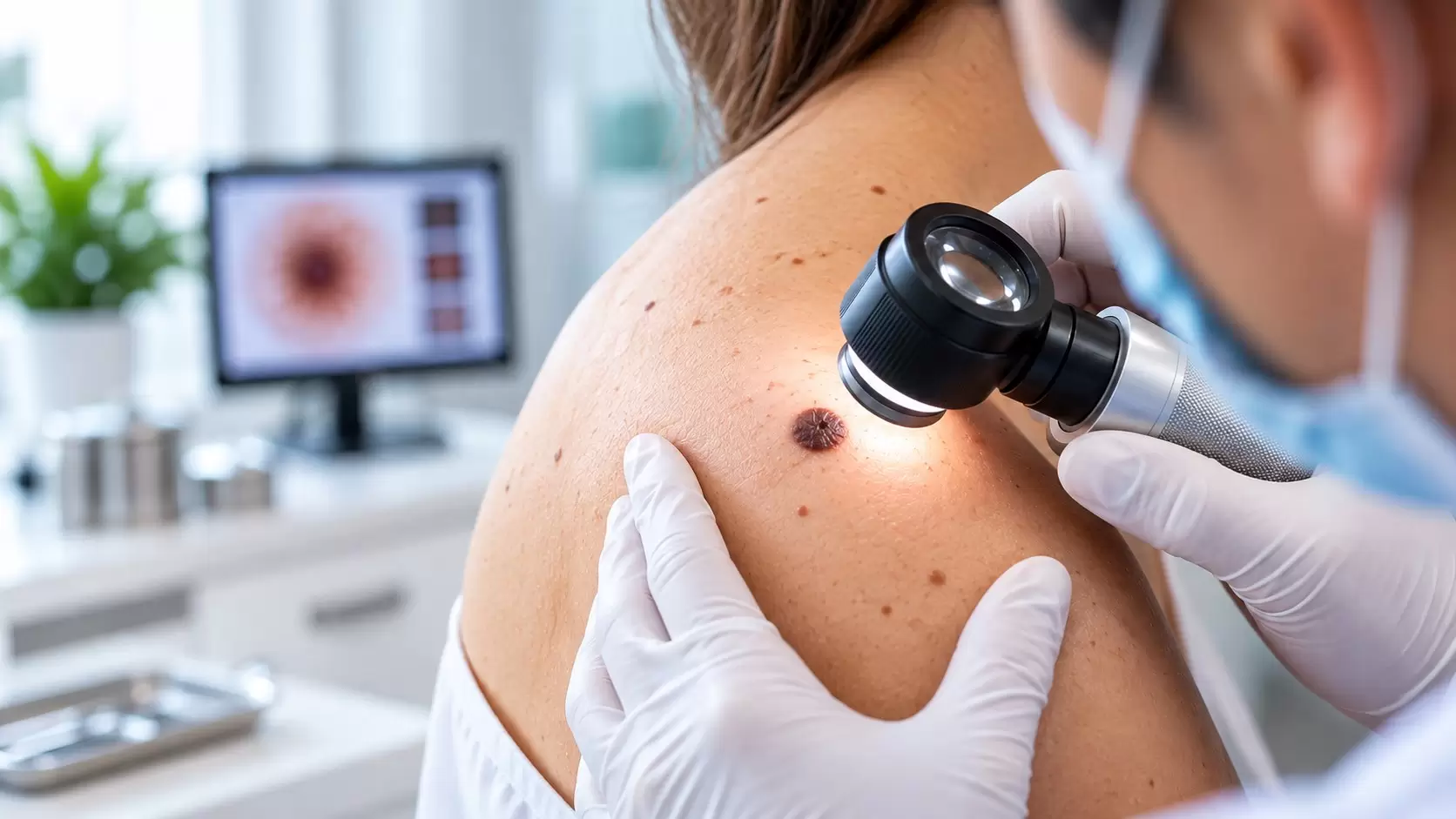
Moles, also called melanocytic naevi, are common skin growths. Many remain stable for years and require no treatment. The reason dermatologists encourage people to notice changes is that melanoma can sometimes develop in an existing mole or appear as a new pigmented spot. If you are concerned about a mole, the aim is not to diagnose it yourself but to recognise when professional assessment is appropriate.
At Ram Skin Clinic’s Mole Assessment & Removal service in Chennai, a dermatologist can examine the lesion and decide whether reassurance, dermoscopic assessment, monitoring, biopsy or removal is appropriate.
The ABCDE warning signs
A — Asymmetry
One half of the mole does not resemble the other half in shape or colour.
B — Border
The edge may be irregular, scalloped, blurred or poorly defined rather than smooth and even.
C — Colour
Several colours or uneven colour distribution within the same lesion can be a reason for assessment.
D — Diameter
Melanomas are often larger than about 6 mm when diagnosed, but they can be smaller. Diameter alone cannot rule melanoma in or out.
E — Evolving
A mole that changes in size, shape, colour or appearance over time deserves attention. Evolution is particularly important because ordinary moles are usually relatively stable.
The “ugly duckling” sign
A spot that looks noticeably different from the person’s other moles can also warrant examination, even if it does not neatly fit every ABCDE criterion.
Other reasons to have a mole examined
Changes are not limited to the ABCDE features. The American Academy of Dermatology advises assessment when a mole looks different from others, changes in any way, or begins to itch or bleed. DermNet also lists crusting as a feature that can justify expert evaluation.
- A new mole appearing in adult life, particularly later adulthood.
- A mole that is growing or becoming raised.
- New itching, tenderness or discomfort.
- Bleeding or crusting without a clear injury.
- A lesion repeatedly irritated by clothing, shaving or combing.
- A spot that simply looks different from the rest of your moles.
These features do not automatically mean skin cancer. Many benign lesions can change or become irritated. They are reasons for assessment rather than reasons to assume a diagnosis.
What happens during a mole assessment?
A dermatologist considers the history of the lesion, including when it appeared and whether it has changed. The skin is then examined clinically. Dermoscopy may be used to view structures and pigment patterns that are not as easy to assess with the naked eye.
If a lesion remains suspicious, tissue diagnosis may be recommended. DermNet notes that lesions suspicious for melanoma are generally excised for histopathology. The exact approach depends on the lesion, its location and the clinical assessment. You can also read our guide to what a skin biopsy is and why it may be performed.
Should every mole be removed?
No. Most moles are harmless and can be left alone. Removal may be considered when a lesion needs histopathological diagnosis, is repeatedly irritated, or for cosmetic reasons after it has been appropriately assessed. A suspicious mole should not simply be treated as a cosmetic spot without first establishing the correct diagnostic plan.
For information about evaluation and removal options, see our Mole Assessment & Removal in Chennai page.
Checking your moles at home
Skin self-examination can help you become familiar with what is normal for you. Look at areas that are easy to overlook, including the scalp, back, palms, soles, between the toes and around the nails. In people with darker skin tones, important lesions can occur on palms, soles or around and under nails as well as elsewhere on the body.
Photographs can sometimes help you notice change over time, but home monitoring should not delay an examination when a lesion has concerning features.
For authoritative patient information, see the American Academy of Dermatology’s ABCDE guide and DermNet’s information on melanocytic naevi.
Frequently asked questions
When should I worry about a mole?
A mole should be assessed if it is changing, has ABCDE features, looks different from your other moles, or develops symptoms such as itching, bleeding or crusting.
Does a mole larger than 6 mm mean melanoma?
No. Size is only one feature. Melanomas can be smaller than 6 mm, while many larger moles are benign. A dermatologist evaluates the complete clinical picture.
Can a normal mole change?
Some benign moles can change over time, and changes can occur for non-cancerous reasons. Because evolution is also an important melanoma warning sign, a new or changing lesion should be assessed when appropriate.
Can a dermatologist tell whether a mole is cancerous just by looking?
Clinical examination and dermoscopy can provide important diagnostic information, but if a lesion remains suspicious, histopathological examination of tissue may be needed for diagnosis.
Should I remove a mole at home?
No. Home removal can cause bleeding, infection or scarring and may destroy tissue that should have been examined. A mole should be professionally assessed before removal.
Visit us in OMR
Concerned about a mole or changing spot?
Book a consultation at Ram Skin Clinic in Thoraipakkam, Chennai for dermatologist assessment.
#48, Second Floor, Flat E, Best Towers,Okkiampet, Thoraipakkam, OMR,
Chennai – 600097. Above Domino’s Pizza.