
Androgenetic Alopecia in Men
Male Pattern Hair Loss
Male pattern hair loss, or androgenetic alopecia, is the most common form of hair loss in men. It usually causes gradual recession at the temples, thinning over the crown, or both.
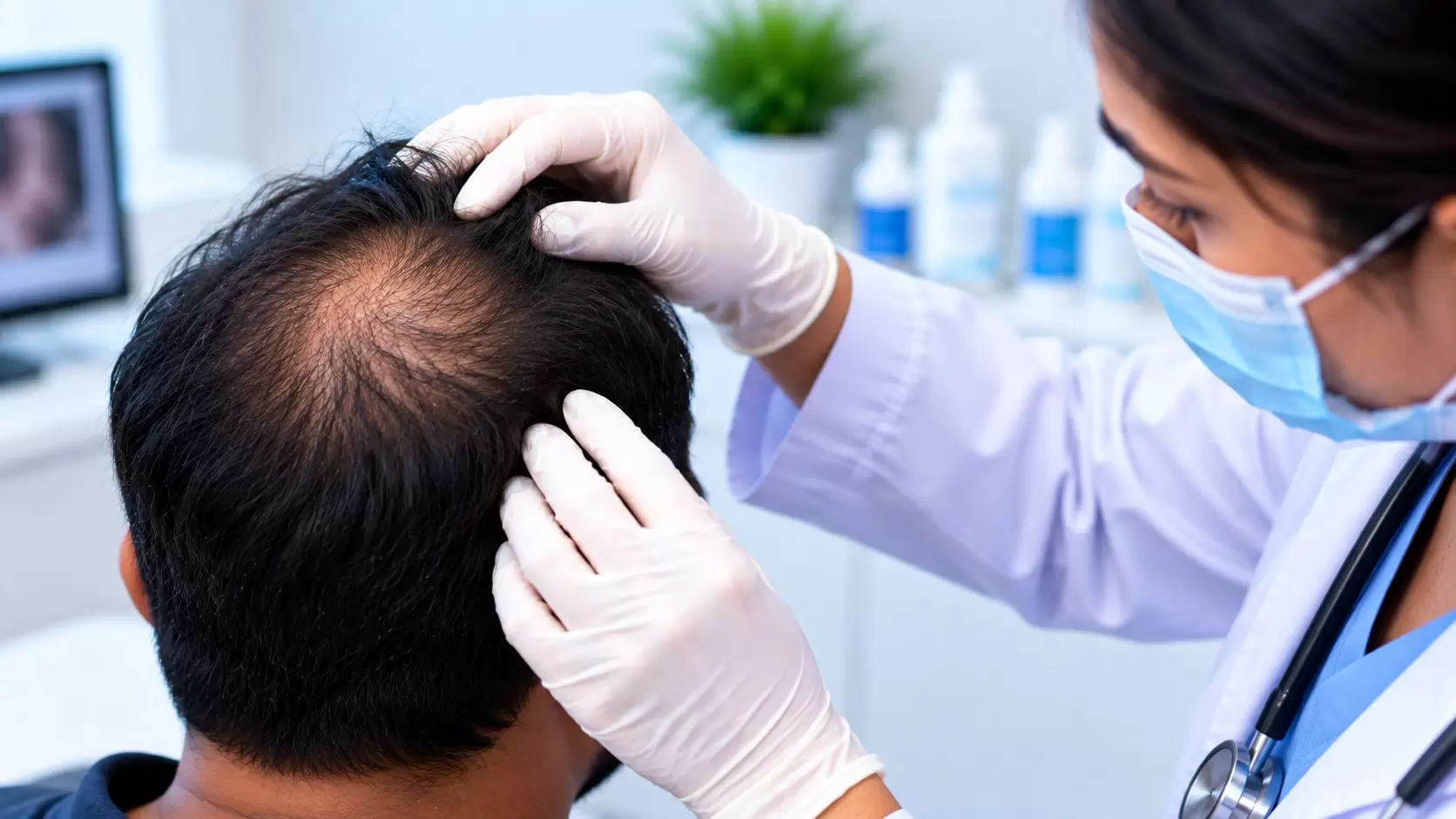
What is male pattern hair loss?
Male pattern hair loss is a hereditary, non-scarring form of alopecia. Instead of suddenly destroying follicles, it gradually changes susceptible follicles so that each growth cycle produces a finer and shorter hair.
Over time, visible scalp increases as terminal hairs become miniaturised. The condition can begin in the late teens or twenties, but onset and rate of progression vary considerably.
What causes male pattern baldness?
The condition reflects both genetic predisposition and androgen activity. In susceptible scalp follicles, dihydrotestosterone (DHT), produced from testosterone by the enzyme 5-alpha-reductase, contributes to progressive follicle miniaturisation.
This does not mean a man with pattern hair loss necessarily has unusually high testosterone. The sensitivity of particular follicles to androgen signalling is central.
For other possible causes of thinning and shedding, see Common Causes of Hair Loss.
Is male pattern hair loss genetic?
Yes. Multiple genes contribute to susceptibility, age of onset, pattern and severity. The common belief that baldness comes only from the mother’s side is an oversimplification; genetic risk can come from either side of the family.
A family history can support the diagnosis, but its absence does not rule male pattern hair loss out.
Early signs to watch for
Temple recession
The frontal hairline may begin moving backward at the temples, creating a more pronounced M-shaped contour.
Crown thinning
Density may gradually decrease at the vertex or crown, sometimes before the change is obvious from the front.
Finer hairs
Miniaturised hairs become shorter and thinner, so an area can look less dense even before it becomes visibly bald.
Slow progression
Changes typically develop gradually over years rather than producing a sudden smooth bald patch.
How does male pattern hair loss progress?
The usual pattern involves the frontal hairline, temples and vertex while hair around the sides and back is relatively preserved. Progression is often described using the Hamilton-Norwood classification.
Not every man follows the same sequence or reaches advanced baldness. Some retain mild recession for years, while others progress more substantially.
Male pattern hair loss vs normal shedding
Normal daily shedding occurs as individual hairs complete their growth cycle. Pattern hair loss is different: the key process is progressive miniaturisation in a recognisable distribution.
Sudden heavy shedding across the entire scalp may suggest telogen effluvium or another process, although more than one type of hair loss can occur at the same time.
How is it diagnosed?
Diagnosis is usually based on the characteristic distribution, history and scalp examination. Dermoscopy can help show variation in hair-shaft diameter and follicular miniaturisation.
Blood tests are not automatically necessary for a typical male-pattern presentation. They may be selected when the history or examination suggests another cause of hair loss.
Treatment options for male pattern hair loss
Evidence-based options include topical minoxidil and prescription finasteride for appropriate adult men. These treatments work through different mechanisms and generally require continued use to maintain benefit.
Depending on the individual, a dermatologist may also discuss hair transplantation, selected device-based approaches or adjunctive procedures. The appropriate plan depends on age, extent of loss, medical history, expectations and treatment risks.
What should you know about minoxidil?
Topical minoxidil can reduce further loss and stimulate growth in some men. Visible improvement takes months rather than weeks, and continued use is needed to maintain its benefit.
Scalp irritation can occur. A dermatologist can help determine whether minoxidil is appropriate and how it fits into a broader treatment plan.
What should you know about finasteride?
Finasteride is a prescription 5-alpha-reductase inhibitor used for male pattern hair loss. By reducing DHT, it can slow progression and may improve hair density in some men.
Because prescription treatment has potential adverse effects and individual contraindications, benefits and risks should be discussed with the prescribing doctor rather than starting treatment based only on online advice.
Can lost hair grow back?
Some miniaturised follicles can produce thicker hairs with effective treatment, particularly when therapy begins earlier. Complete restoration of a previously dense hairline should not be assumed.
When hair loss is advanced and stable, hair transplantation may be considered for suitable candidates, using follicles from areas that are more resistant to androgen-related miniaturisation.
When should you see a dermatologist?
Seek assessment if thinning is progressing, you are unsure whether the pattern is hereditary, or hair loss is sudden, patchy, painful, inflamed or associated with scalp scaling or scarring. Those features can point to another diagnosis.
For diagnosis and an individual plan, visit Hair Loss Treatment in Chennai.
Frequently asked questions
What causes male pattern hair loss?
Genetic susceptibility and the effects of androgens, particularly DHT, on susceptible scalp follicles cause progressive miniaturisation.
What are the early signs?
Common early signs include temple recession, a changing frontal hairline and thinning at the crown.
Can it start in the twenties?
Yes. It can begin in the late teens or twenties in genetically susceptible men.
Can male pattern hair loss be treated?
Yes. Treatment can slow further loss and may improve density, particularly when started early.
Does it come only from the mother’s side?
No. Genetic susceptibility is complex and can be inherited from either side of the family.
Visit us in OMR
Seeing a receding hairline or crown thinning? Get it assessed early.
Book a dermatologist consultation at Ram Skin Clinic in Thoraipakkam, Chennai.
#48, Second Floor, Flat E, Best Towers,Okkiampet, Thoraipakkam, OMR,
Chennai – 600097. Above Domino’s Pizza.